
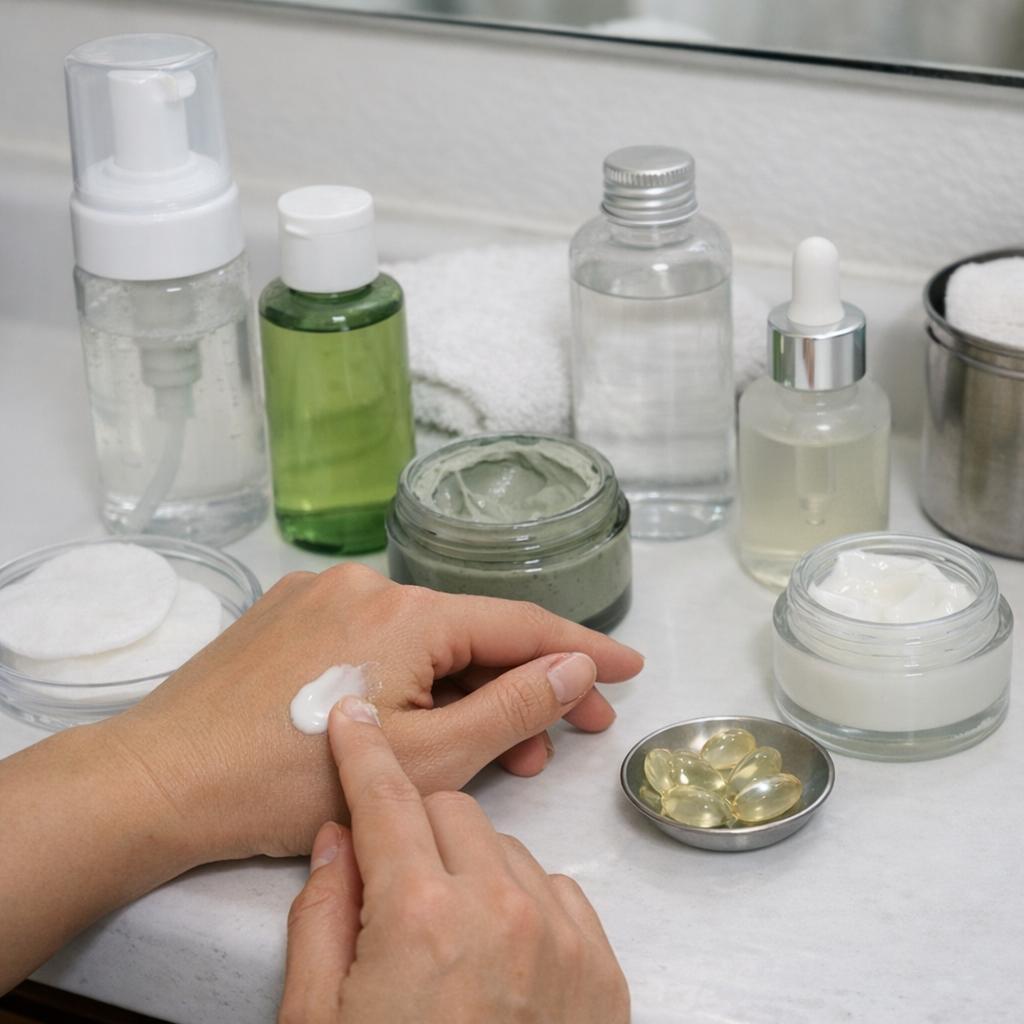
Oily skin usually responds best to a routine that removes excess surface oil without leaving the skin tight, stinging, or persistently flaky. A practical starting point is a gentle cleanser, a lightweight moisturizer as needed, and broad-spectrum sunscreen every morning. At night, remove sunscreen or makeup, cleanse gently, and add one targeted active only when addressing clogged pores or breakouts. Introduce products gradually and aim for comfortable skin rather than a completely matte finish.
The short answer: Oiliness is influenced by sebum production, genetics, hormones, climate, stress, products, and sometimes medicines or health changes. Harsh cleansing does not reliably reduce underlying oil production and may cause tightness, irritation, flaking, or rough texture. A balanced routine manages excess surface oil while preserving skin comfort.
Why does skin become oily?
Sebum is an oily substance made by glands connected to hair follicles. It helps reduce water loss and contributes to the skin’s surface environment. The amount produced varies among people and can change with age, hormonal shifts, climate, stress, and certain medicines.
Oiliness can also vary across the face. The forehead, nose, and chin often appear shinier than the cheeks, so treating every area in the same way may cause unnecessary dryness. Some people have oily skin with sensitivity, flaking, or breakouts; others mainly notice shine without clogged pores. The routine should reflect the concern rather than oiliness alone.
Stripping the skin is sometimes said to cause a predictable amount of “rebound oil,” but the biology is not that simple. Harsh products can disrupt comfort and contribute to dryness, scaling, irritation, or a rougher appearance, which may make oiliness feel more noticeable. Avoiding over-cleansing is sensible, but no routine can guarantee reduced sebum production.
A simple morning routine for oily skin
| Step | Practical starting point | Adjust if needed |
|---|---|---|
| Cleanse | Rinse with lukewarm water or use a gentle cleanser | Use cleanser when there is noticeable oil, sweat, or overnight residue |
| Moisturize | Apply a lightweight lotion, gel-cream, or fluid | Use less or apply only to drier areas if it feels greasy |
| Protect | Use broad-spectrum sunscreen labeled SPF 30 or higher | Try a fluid, gel, lotion, or lighter cream if richer formulas feel heavy |
Should oily skin be cleansed in the morning?
It depends on how the skin feels. If there is little residue from the night before, rinsing with lukewarm water may be enough. If there is noticeable oil, sweat, or product buildup, use a gentle cleanser and rinse thoroughly.
A suitable cleanser should remove surface oil without leaving a tight, squeaky, burning, or unusually dry feeling. Low-lather and moderately foaming formulas can both work; foam level alone does not determine whether a cleanser is harsh. The full formula, contact time, frequency, and individual tolerance matter. Fragrance, essential oils, high levels of denatured alcohol, or strong cleansing agents may irritate some people, but no single ingredient makes a product unsuitable for everyone.
Use fingertips rather than a rough cloth or cleansing brush, avoid very hot water, and do not assume that a longer wash or repeated passes will clean the skin more effectively.
Does oily skin need moisturizer?
Often, yes. Oily skin can still become dry, uncomfortable, or easily irritated. A moisturizer helps reduce water loss and maintain a comfortable surface. Lightweight lotions, gel-creams, and fluids may be easier to tolerate than rich creams, although texture preference varies.
Common ingredients in lightweight moisturizers include glycerin, panthenol, hyaluronic acid, beta-glucan, ceramides, and dimethicone. Niacinamide is also used in many formulas and may support the moisture barrier and overall appearance. None of these ingredients is essential, and a plain moisturizer may be preferable if a complex formula stings.
Applying moisturizer to slightly damp skin may feel comfortable. If it leaves a greasy film, try using less, limiting it to drier areas, or choosing a lighter texture. “Oil-free” does not automatically mean non-irritating, and a product containing oil is not automatically pore-clogging for every person.
What kind of sunscreen suits oily skin?
Choose a broad-spectrum sunscreen labeled SPF 30 or higher. Apply it as directed and reapply according to the label, particularly during outdoor exposure, sweating, or swimming. Fluids, gels, lotions, and lighter creams may feel more comfortable than rich formulas. Some have a matte finish; others are more moisturizing. The best option is one that can be applied adequately and worn consistently.
Do not rely on makeup, moisturizer, shade, or a matte finish as a substitute for sunscreen. If a sunscreen pills, feels heavy, or irritates the eyes, changing formulas may help. Mineral and chemical filters have different sensory qualities, but neither category is universally better for oily skin.
How to build a balanced evening routine
Is double cleansing necessary?
Not every night. When wearing water-resistant sunscreen, makeup, or another difficult-to-remove product, a first step such as micellar water or a cleansing balm may help. Follow with a gentle cleanser when needed. On days without those products, one thorough cleanse may be enough.
Automatic double cleansing can be too drying for some oily skin. Avoid scrubbing to remove residue. If a first cleanser leaves a film, rinse more carefully or try a different formula instead of repeatedly washing.
Should you add an acne active?
Add one only for a defined concern such as recurring blackheads, whiteheads, or pimples. Oiliness by itself does not require acne treatment. Common over-the-counter options include salicylic acid, benzoyl peroxide, and adapalene, but they serve different purposes and have different irritation risks. Follow the current label and avoid introducing several actives at once.
- Salicylic acid: Often used to exfoliate within pores and may help some forms of congestion. Overuse can cause dryness or irritation.
- Benzoyl peroxide: Commonly used for inflammatory acne. It can dry or irritate the skin and may bleach fabrics.
- Adapalene: A topical retinoid used for acne. It can cause irritation and is not appropriate for everyone, including some people who are pregnant or trying to become pregnant.
When the label permits, begin with its least frequent use and apply a thin layer to the intended area. If the skin becomes persistently painful, raw, swollen, or markedly irritated, stop the suspected nonprescription product and seek professional guidance rather than adding another treatment.
Weekly and occasional ways to manage shine
A complicated weekly program is unnecessary. Blotting papers can temporarily reduce surface shine without another cleanser or active. Press rather than rub. Blotting changes the appearance of oil but does not affect its underlying production.
Clay masks may absorb surface oil for a short time, but they do not permanently change sebum production. Follow the label, avoid irritated or peeling skin, and do not wait for a mask to dry until it cracks. Applying it only to oilier areas may limit unnecessary dryness. Stop if it burns, stings, or causes prolonged redness.
Frequent scrubs, cleansing brushes, alcohol-heavy toners, repeated “detox” treatments, and excessive washing can add irritation without lasting oil-control benefits. A modest, consistent routine is easier to assess than a cycle of aggressive changes.
Match the routine to the goal
| Goal | Lower-irritation starting point | Important limitation |
|---|---|---|
| Reduce surface shine | Gentle cleansing, blotting papers, or a comfortable natural- or matte-finish sunscreen | These affect surface appearance, not necessarily sebum production |
| Improve comfort | A lightweight moisturizer with humectants or barrier-supportive ingredients | Any formula may irritate if it is not well tolerated |
| Address clogged pores | One salicylic-acid product used according to its label | Results vary, and overuse may cause dryness or irritation |
| Address recurring pimples | One appropriate acne active or professional evaluation | The best option depends on the type, extent, duration, and severity of the breakouts |
| Remove sunscreen or makeup | One effective cleanse, or a first cleanse followed by a gentle cleanser when needed | Repeated cleansing is not automatically more effective |
Signs the routine may be too drying
- The skin feels tight, squeaky, hot, or uncomfortable after cleansing.
- Flaking, roughness, persistent redness, or stinging develops.
- Moisturizer or sunscreen begins to burn on application.
- Several oil-control products are being layered over the same area.
- The routine is being intensified mainly to maintain a completely matte finish.
When these signs appear, simplify the routine rather than adding another exfoliant or cleanser. Temporarily pause the suspected irritating nonprescription product, use a gentler base routine, and reassess comfort.
Who should be especially cautious?
- People with eczema, rosacea, contact reactions, or very sensitive skin should introduce products carefully and may benefit from professional advice.
- Anyone using prescription skin treatments should follow the prescriber’s directions and ask before adding exfoliants, retinoids, benzoyl peroxide, or other actives.
- People who are pregnant, trying to become pregnant, or breastfeeding should ask a qualified clinician or pharmacist about acne actives when uncertain.
- Children and younger teenagers may need a simpler routine and guidance from a parent, pharmacist, or clinician rather than a complex adult regimen.
- A sudden change after starting a medicine, supplement, hormonal treatment, or personal-care product should be discussed with a qualified professional.
Stop and seek professional advice if
- Oiliness changes suddenly and persists without an obvious product, climate, or routine explanation.
- There is painful swelling, widespread redness, crusting, pus, significant itching, or a spreading rash.
- Breakouts are deep, painful, scarring, rapidly worsening, or affecting emotional well-being.
- A product causes facial swelling, hives, blistering, severe burning, or difficulty breathing. Seek urgent care for breathing difficulty or swelling involving the mouth or throat.
- Dryness, peeling, or sensitivity continues after stopping a suspected irritating nonprescription product.
A practical decision process
- Define the main concern. Is the priority shine, discomfort, clogged pores, pimples, sunscreen feel, or a combination? Trying to address everything at once makes irritation and troubleshooting more likely.
- Establish the base routine. Use a comfortable cleanser, a lightweight moisturizer as needed, and sunscreen every morning.
- Adjust by area. Use less moisturizer on the oilier T-zone or reserve an oil-control step for that area rather than drying the whole face.
- Add one targeted product when there is a clear reason. Follow its label, avoid damaged skin, and do not introduce multiple actives together.
- Track comfort, not just shine. Less flaking, reduced stinging, and comfortable cleansing are more useful signals than a temporarily tight or powdery finish.
- Reassess before escalating. If the concern persists, worsens, or does not fit a straightforward skincare issue, consult a qualified clinician or pharmacist.
Patch testing: Testing a new product on a small area can reduce the chance of applying a likely irritant broadly, although it cannot predict every reaction. Follow the product instructions and stop if concerning symptoms develop.
Frequently asked questions
Should oily skin skip moisturizer?
Not automatically. Oily skin can still become dry or uncomfortable because of cleansing, weather, or acne treatments. A lightweight moisturizer may improve comfort. Adjust the amount, texture, and placement according to how the skin feels.
Does washing oily skin more often reduce oil?
It removes surface oil temporarily but does not necessarily reduce the amount produced. Repeated washing may contribute to tightness and irritation. Cleanse when needed rather than washing repeatedly to maintain a completely matte finish.
Is niacinamide necessary?
No. Niacinamide is optional. It is used in many products and may support the appearance of pores, redness, and uneven texture for some people, but a routine can remain effective without it. Higher concentrations are not automatically better and may be less comfortable.
Can clay masks permanently control oil?
No. Clay can absorb surface oil for a limited time but does not permanently change the glands that produce sebum. Keep use occasional, follow the label, and stop if it causes burning or prolonged tightness.
Can oily skin also be dehydrated?
Yes. Oil and water content are different. Skin may look shiny while also feeling tight, flaky, or irritated. Gentler cleansing and a lightweight moisturizer may be more useful than adding another oil-removing product.
When should oily skin and acne be evaluated?
Seek professional advice for painful or scarring breakouts, sudden changes, persistent irritation, or acne that does not improve with careful use of appropriate over-the-counter products.
Oily skin does not need to be stripped or treated as a problem to eliminate. A useful routine removes excess residue, maintains comfort, protects against ultraviolet exposure, and uses targeted treatment only for a clear concern. Consistency is generally more helpful than repeatedly changing products in pursuit of a completely matte finish.
Sources and further reading
These resources provide additional medical and skincare context:
- Acne: Tips for managing — American Academy of Dermatology Association
- Face washing 101 — American Academy of Dermatology Association
- How to treat different types of acne — American Academy of Dermatology Association
Safety note
This guide provides general education, not diagnosis or individualized treatment. Follow current product labels and seek qualified care for severe, persistent, painful, infected, rapidly changing, or otherwise concerning symptoms.