
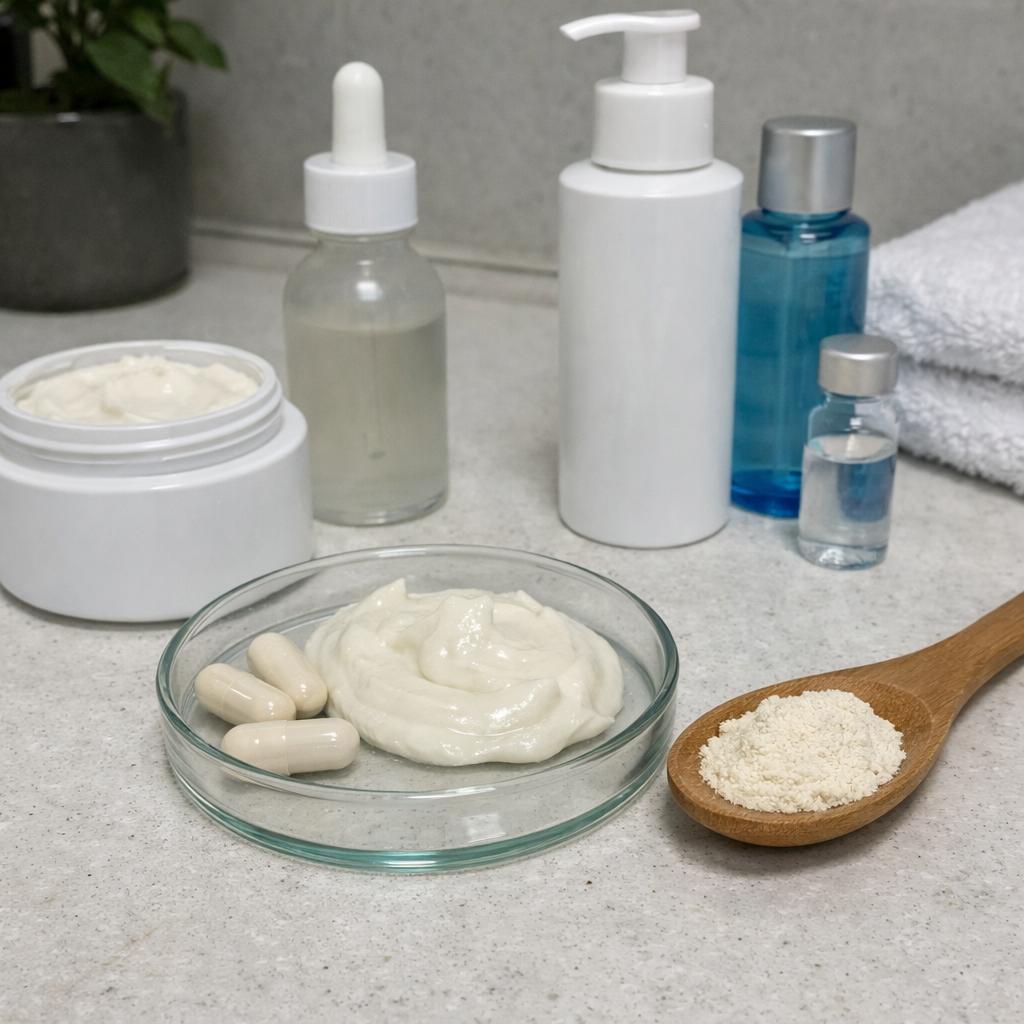
Practical answer: A ceramide moisturizer may help if your skin feels dry, tight, rough, or easily irritated, but the ingredient name alone does not determine whether a product will suit you. Evaluate the entire formula, including its texture, humectants, occlusives, fragrance, and potential irritants. Ceramides support the skin’s outer barrier; they do not address every cause of redness, flaking, acne, or sensitivity. A simple moisturizer used consistently is often more useful than the product with the longest ceramide list.
What are ceramides, and why are they used in skincare?
Ceramides are a family of waxy lipids naturally found in the outermost layers of skin. They work with cholesterol and fatty acids to form an organized barrier between skin cells. This barrier helps limit water loss and reduces contact between deeper skin layers and outside irritants.
A useful comparison is a brick wall: skin cells are the bricks, while ceramides, cholesterol, and fatty acids form part of the mortar. The analogy is simplified, but it explains why water-binding ingredients alone may not feel sufficient for persistently dry skin. Humectants attract water, while barrier-supporting lipids and occlusive ingredients help slow its escape.
Skin produces ceramides naturally, but their amount and organization can vary with age, environmental conditions, cleansing habits, inflammation, and some skin conditions. A topical product can supplement surface lipids, but it does not permanently change skin biology or correct every underlying problem.
What can ceramides do for skin?
Help reduce moisture loss
In a well-formulated moisturizer, ceramides may help the outer barrier retain water more effectively. This can make dry skin feel less tight and more comfortable. Results also depend on the cause and severity of dryness, the climate, cleansing practices, the rest of the formula, and consistent use.
Ceramides are not standalone hydrators. Glycerin, hyaluronic acid, and other humectants attract water. Petrolatum, dimethicone, plant oils, waxes, and other emollient or occlusive ingredients can smooth rough areas or reduce evaporation. Many useful moisturizers combine these ingredient groups.
Support tolerance to everyday exposure
A more intact outer barrier may make skin less vulnerable to some environmental stressors and irritants. However, ceramides do not make skin immune to allergens, pollution, harsh products, over-cleansing, or excessive exfoliation.
If a moisturizer causes burning, itching, swelling, or a worsening rash, its ceramide content does not make it appropriate. Another ingredient, the preservative system, or the condition of the skin may be contributing.
Improve the appearance of surface dryness
Ceramides are not exfoliating acids, retinoids, or scrubbing agents. A ceramide moisturizer may make roughness and flaking look better by improving hydration and reducing surface dryness, but it does not accelerate exfoliation. Adding an exfoliant may increase irritation when skin is already uncomfortable.
Provide supportive rather than direct anti-inflammatory care
Ceramides are not generally used as direct anti-inflammatory treatments. Supporting the barrier may help interrupt a cycle in which dryness and irritant exposure contribute to discomfort. Persistent redness, itching, scaling, pain, or oozing needs more specific assessment rather than repeated use of barrier products alone.
Who may find a ceramide moisturizer useful?
Ceramide products are commonly considered when skin feels dry, tight, rough, or uncomfortable after cleansing. They may also provide moisturizing support in routines containing potentially drying products, although they cannot guarantee tolerance to a retinoid, acne treatment, exfoliant, or other active ingredient.
People with oily or blemish-prone skin can use ceramides too. The practical question is whether the product’s vehicle suits the skin and the user’s preferences. A lotion, gel-cream, or fluid may feel more comfortable than a rich balm. A heavier product may help very dry areas but feel unpleasant or congesting for some people.
Ceramide moisturizers are also often used as supportive care for eczema and other forms of dermatitis. They may improve hydration and comfort, but an over-the-counter moisturizer does not replace an appropriate treatment plan during a flare. Product selection may need to account for allergies, infection risk, age, body area, and prescribed treatments.
How should you evaluate a ceramide product?
Do not judge it by the number of ceramides
Ingredient labels may use names such as Ceramide NP, Ceramide AP, Ceramide EOP, Ceramide NS, or similar International Nomenclature Cosmetic Ingredient terms. A product may be useful with one listed ceramide, several types, or a broader mixture of barrier-supporting lipids. There is no simple rule that three ceramides are always better than one.
Labels generally do not reveal the exact concentration, quality, delivery system, or performance of a ceramide formula. Ingredient-list position provides limited context and is not a precise measure of effectiveness. A long ceramide list offers little practical value if the product stings, feels unpleasant, or is not used consistently.
Consider cholesterol and fatty acids without trying to calculate a ratio
In skin, ceramides are part of a larger lipid system that includes cholesterol and fatty acids. Some formulas combine these ingredients to imitate aspects of that system. This can be a thoughtful formulation choice, but consumers do not need to calculate a specific ratio at home.
A formula does not have to display a particular lipid ratio—or contain all three categories—to be useful. Performance depends on the full composition, manufacturing, stability, application, and individual tolerance.
Look for supporting ingredients that match your goal
| Ingredient group | Potential role | What to consider |
|---|---|---|
| Glycerin and other humectants | Draw water toward the outer skin layers | Helpful for hydration but may not be sufficient alone for very dry skin |
| Petrolatum, dimethicone, and similar occlusives | Reduce water evaporation and protect rough areas | More occlusive formulas can feel heavy |
| Fatty alcohols and oils | Soften and smooth the skin | Fatty alcohols are not the same as drying alcohols |
| Panthenol or colloidal oatmeal | May add soothing or moisturizing benefits | Benefits depend on the full formula and individual tolerance |
| Niacinamide | May support barrier function and provide other cosmetic benefits | Can irritate some people, especially at higher concentrations or on reactive skin |
More ingredients do not necessarily make a better moisturizer. A fragrance-free formula with a relatively short ingredient list may be easier to evaluate when skin is already uncomfortable.
Match the texture to the area and routine
Texture affects comfort, consistency of use, and the amount of protection a product provides. Lotions and gel-creams are usually lighter. Creams generally offer more emollience. Balms and ointments tend to be more occlusive but may feel greasy or sit poorly under makeup.
| Product texture | May suit | What to consider |
|---|---|---|
| Lotion or fluid | People who prefer a light finish or apply moisturizer under sunscreen | May not be enough for very dry areas |
| Gel-cream | People seeking hydration without a rich finish | Check for fragrance, cooling agents, or other ingredients that may sting |
| Cream | Dry or seasonally dehydrated skin | Often balances emollience with ease of use |
| Balm or ointment | Small, very dry areas needing more occlusion | Can feel heavy and may not be preferred on acne-prone areas |
What product claims can and cannot tell you
Reasonable expectations
- A ceramide moisturizer may support surface hydration and barrier function.
- A richer formula may reduce tightness more effectively than a very light lotion.
- A fragrance-free, uncomplicated product may be easier to tolerate when skin is sensitive.
- Consistent moisturizing may improve comfort over time.
Important limitations
- A product label cannot identify the cause of redness, itching, scaling, or burning.
- Ceramide content cannot confirm eczema, acne, an allergy, or a “damaged barrier.”
- A moisturizer cannot replace prescribed treatment or professional evaluation.
- Ceramides cannot guarantee tolerance to another active ingredient.
Claims such as “repairs the barrier” are best understood as cosmetic or supportive language. A moisturizer may improve comfort without addressing why the symptoms began.
How can ceramides fit into a skincare routine?
A ceramide moisturizer can generally be applied after cleansing and after other suitable treatment products. It does not usually require a special pH, waiting period, or time of day.
- Cleanse gently. Follow the cleanser label and avoid very hot water, vigorous scrubbing, or repeated cleansing if these make the skin feel worse.
- Apply moisturizer without excessive rubbing. If comfortable, slightly damp skin may make the product easier to spread.
- Use a practical texture. A lighter moisturizer used regularly may be more helpful than a heavy product that is quickly abandoned.
- Use daytime sun protection. A ceramide moisturizer does not replace sunscreen or other sun-protective measures.
- Introduce one change at a time. This makes it easier to determine whether a new product is helpful, neutral, or irritating.
If your routine includes a prescription treatment, follow its instructions rather than changing it based on general skincare information. A pharmacist or prescribing clinician can explain how to use a moisturizer alongside it.
What results are realistic?
Some people notice less tightness or greater comfort after several applications. Visible roughness and flaking may take longer to improve. Results vary with the formula, environment, cleansing routine, consistency of use, and cause of the symptoms.
Ceramides are not expected to produce the changes associated with exfoliating or pigment-targeting ingredients. Their role is usually supportive: reducing dryness, making a routine more comfortable, and providing a basic moisturizing step. If a product does not help after reasonable, label-directed use, applying more is not necessarily the answer. The formula may be unsuitable, or the symptoms may need professional assessment.
Who should be cautious?
- People with known allergies or previous reactions: Review the complete ingredient list rather than focusing only on ceramides. “Fragrance-free” and “hypoallergenic” are not guarantees.
- People with very reactive or broken skin: Even normally well-tolerated ingredients can sting when skin is raw.
- Children, infants, and people who are pregnant or breastfeeding: Ask a qualified healthcare professional when symptoms are significant or the formula contains additional active ingredients.
- People using prescriptions or recovering from procedures: Follow the clinician’s aftercare instructions. A cosmetic product may not be appropriate immediately after a peel, laser treatment, microneedling, surgery, or another procedure.
- People with acne-prone skin: Consider the complete vehicle and whether it feels congesting. Ceramides alone do not determine whether a moisturizer will contribute to breakouts.
Stop using the product and seek professional advice if
- Burning, swelling, hives, severe itching, blistering, or rapidly worsening redness develops.
- A rash becomes painful, warm, spreading, crusted, draining, or associated with fever.
- Eye, lip, or facial swelling occurs. Seek emergency care if swelling is accompanied by trouble breathing or swallowing.
- Dryness, scaling, itching, or redness persists despite a simple routine and label-directed moisturizer use.
- Symptoms repeatedly return, interfere with sleep or daily activities, or affect a child or infant.
- Skin changes begin after a procedure or during prescribed treatment and the aftercare instructions are unclear.
A practical decision checklist
1. Define the goal. Decide whether you want less tightness, a lighter everyday moisturizer, more comfort in dry weather, or moisturizing support alongside another product.
2. Read the full ingredient list. Look for ceramides if they are a priority, then check for humectants, occlusives, fragrance, essential oils, exfoliating acids, and ingredients you already know you do not tolerate.
3. Choose the texture by area. Consider a lotion or gel-cream for a lighter finish, a cream for general dryness, or a balm or ointment for areas needing more occlusion.
4. Do not overinterpret ceramide numbers. Multiple ceramide types, cholesterol, and fatty acids can be reasonable formulation features, but they do not guarantee better results.
5. Change one variable at a time. Introducing several products together makes it difficult to identify what helped or caused irritation.
6. Reassess based on comfort and tolerance. Look for reduced tightness, less surface dryness, and comfortable regular use rather than a dramatic transformation.
In short, ceramides are best understood as one part of a complete moisturizing formula. A suitable product may support the outer barrier and improve comfort, but texture, supporting ingredients, individual tolerance, and the cause of the skin concern all matter.
Frequently asked questions
Can ceramides be used with retinoids or exfoliating acids?
They are commonly included in routines containing these ingredients because a moisturizer may help with dryness. However, ceramides do not guarantee tolerance to a retinoid or acid. Follow the product label and any instructions from the prescribing clinician.
Are ceramides suitable for oily or acne-prone skin?
Often, yes. The texture and complete formula matter more than the ceramide label. A lightweight lotion or gel-cream may feel more comfortable than an ointment. If a moisturizer repeatedly appears to worsen clogged pores or breakouts, it may not be a good fit.
Is a product better if it contains several ceramide types?
Not automatically. Several types may reflect a thoughtful formula, but performance also depends on concentration, supporting lipids, texture, stability, and individual tolerance. A single-ceramide moisturizer can still be a reasonable option.
How quickly should a ceramide moisturizer work?
Comfort and tightness may improve relatively soon for some people, while roughness or flaking may take longer. There is no universal timeline. Persistent or worsening symptoms are not a reason to keep applying increasing amounts indefinitely.
Can ceramides treat eczema or dermatitis?
Ceramide moisturizers are often used as supportive care for eczema and dermatitis, but they do not replace diagnosis or treatment. Recurrent, severe, infected-looking, or sleep-disrupting symptoms deserve medical evaluation.
Sources and further reading
These resources provide general medical and skin-barrier context:
- How to relieve dry skin — American Academy of Dermatology Association
- Skin care basics — American Academy of Dermatology Association
- Skin barrier overview — National Library of Medicine
Safety note
This guide provides general education, not diagnosis or individualized treatment. Read the current product label and seek qualified care for severe, persistent, painful, infected, rapidly changing, or otherwise concerning symptoms.