
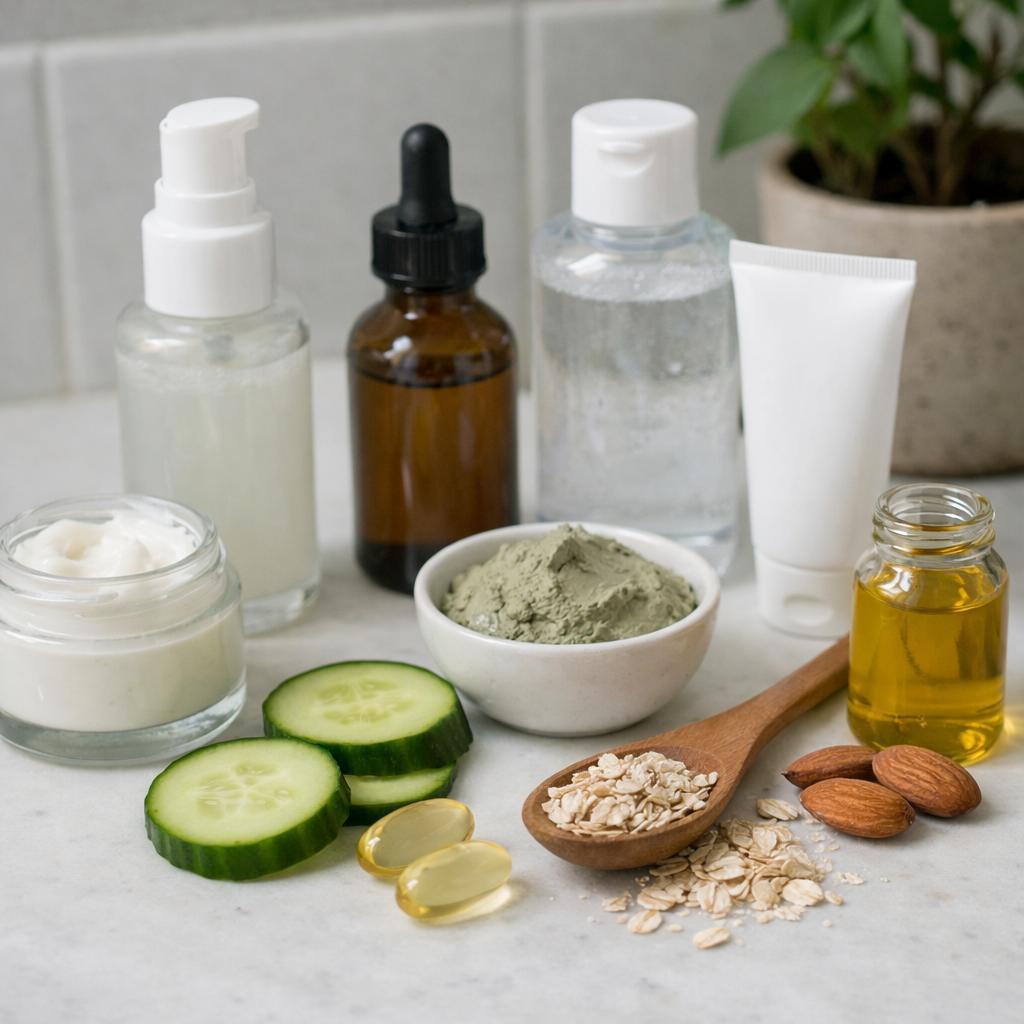
A gentle anti-aging routine does not need to cause burning, peeling, or persistent redness. Start with broad-spectrum sunscreen, a cleanser that does not leave skin uncomfortably tight, and a moisturizer suited to your skin. If you want an active ingredient, choose one, introduce it gradually, and assess tolerance before adding anything else. Retinoids, vitamin C, niacinamide, peptides, and mild exfoliating acids may have a place, but none is essential for everyone. The most useful routine is one you can maintain without repeatedly irritating your skin.
What is the simplest effective approach?
Build the routine in layers of priority: protect skin from ultraviolet exposure, support comfortable hydration, and then consider one targeted active if it suits your goal and tolerance. Follow current product labels. A stronger concentration or more frequent application does not necessarily produce faster improvement.
Morning
Cleanse if needed, moisturize if helpful, and apply broad-spectrum SPF 30 or higher. Vitamin C or niacinamide is optional.
Evening
Remove sunscreen and makeup with a gentle cleanser, moisturize, and use no more than one treatment active on a given night.
Throughout the week
Include uncomplicated recovery nights. More products are not automatically more protective or effective.
Why does a conservative routine make sense?
Visible skin changes are influenced by ultraviolet exposure, natural changes over time, genetics, hormones, smoking, environmental conditions, and other factors. Skincare may improve the appearance of dryness, uneven tone, rough texture, and some fine lines, but it cannot stop aging or reproduce the results of a medical procedure.
Harshness is not a reliable measure of effectiveness. Stinging can indicate irritation rather than useful activity, and repeated irritation may leave skin temporarily red, flaky, dry, or more lined. A milder product used consistently may be more useful than an effective product that is impossible to tolerate.
A conservative routine also makes it easier to identify what helps and what causes trouble. Starting several actives at once can obscure the cause of a reaction and lead to unnecessary product switching.
Which steps matter most?
1. Use sun protection consistently
Broad-spectrum sunscreen helps reduce ultraviolet exposure, which contributes to visible changes such as uneven pigmentation, roughness, and loss of elasticity. Choose an SPF 30 or higher product that you are willing to apply in a sufficient amount. Reapply as the label directs, especially during prolonged outdoor activity, sweating, or swimming.
Sun protection also includes shade, hats, sunglasses, clothing, and avoiding unnecessary midday exposure. Sunscreen works best as part of this broader approach, not as permission to remain outside indefinitely.
2. Keep cleansing gentle
Use lukewarm rather than hot water and avoid scrubbing. Evening cleansing can remove sunscreen, makeup, oil, and daily residue. In the morning, some people prefer a water rinse, while others need cleanser. Let skin comfort and the previous night’s products guide the choice.
3. Moisturize for comfort and resilience
Moisturizers can reduce water loss and make dry or rough skin feel more comfortable. Useful ingredients may include glycerin, hyaluronic acid, petrolatum, dimethicone, ceramides, squalane, or other emollients and occlusives. A cream is often more protective than a lightweight lotion, but the best texture is one you can use without feeling greasy, congested, or uncomfortable.
Moisturizer does not prevent every sign of aging, and it does not need a long list of active ingredients. A straightforward formula can support a treatment routine by helping skin remain comfortable.
Which active ingredient fits your goal?
No active is required, and there is no universal order for trying them. Choose according to your main concern, current routine, product directions, and tendency toward irritation. Introduce one new active at a time.
| Ingredient or category | Often used for | Important considerations |
|---|---|---|
| Retinol or another topical retinoid | Fine lines, uneven texture, and some uneven tone | May cause dryness, peeling, or irritation. Follow the label or qualified medical advice. Prescription retinoids require individualized guidance. |
| Vitamin C | Antioxidant support and the appearance of uneven tone | Formulas vary in stability, strength, and tolerability. Tingling is not proof that a product is working. |
| Niacinamide | Supporting the appearance of uneven tone and the skin’s moisture function | Often well tolerated, although higher concentrations can irritate some people. |
| Peptides | Conditioning and supporting a smoother-looking appearance | Formulas and evidence vary. Noticeable results may be subtle. |
| Alpha hydroxy acids such as lactic acid | Surface roughness and dull-looking skin | Can increase irritation and sun sensitivity depending on the formula. Avoid combining several exfoliants without a clear reason. |
Should retinol be part of the routine?
Retinol is a nonprescription retinoid commonly used for the appearance of fine lines, texture, and uneven tone. It may be useful, but it is not appropriate for everyone and is not the only option. Products differ in concentration, formulation, and instructions, so follow the label rather than copying someone else’s schedule.
If you try retinol, begin with a small amount and infrequent use only when the label supports that approach. Apply it to clean, dry skin if directed, and use moisturizer as needed. Do not apply it to visibly irritated, sunburned, or broken skin. Avoid adding an exfoliating acid, another retinoid, or several potentially irritating products at the same time.
Prescription retinoids can be more potent and have different instructions and risks. Do not begin, stop, or change a prescription treatment based on general skincare guidance. Ask the prescriber or pharmacist how to use it with the rest of your routine.
Are gentler alternatives equivalent?
Not necessarily. Bakuchiol, peptides, niacinamide, and vitamin C derivatives may appeal to people who do not want a retinoid or are concerned about irritation, but their effects and supporting evidence are not identical. A gentler ingredient may be easier to tolerate, while another may have more evidence for a particular concern. Pregnancy and breastfeeding considerations also vary by ingredient and product. Ask a qualified healthcare professional before using retinoids during pregnancy or if pregnancy is possible.
How should new products be introduced?
There is no universal schedule because tolerance depends on the product, concentration, formulation, other products, and individual skin. A cautious process can reduce avoidable problems.
- Read the current label, including directions, warnings, storage instructions, and use restrictions.
- Review the rest of your routine and remove unnecessary overlapping actives.
- Consider testing a small amount on a limited area as the manufacturer directs. This cannot guarantee that the product will not irritate your face.
- Introduce the product by itself rather than alongside another new treatment.
- Observe your skin over time. Stop using the product and seek advice for persistent discomfort, worsening redness, swelling, blistering, or another concerning reaction.
Some people apply moisturizer before or after a potentially irritating active for comfort. This may reduce the intensity of contact for some formulas, but it may also change how a product spreads or performs. Follow any application method specified on the label.
What might a weekly routine look like?
This is a framework rather than a prescription or universal schedule. Cleanser, moisturizer, and sunscreen can form a complete routine without active ingredients. If you choose a treatment, keep the remaining steps simple.
- Basic mornings: Cleanse or rinse as appropriate, moisturize if needed, and apply broad-spectrum sunscreen.
- Active evenings: Cleanse, apply one chosen active according to its label, and moisturize if helpful.
- Simple evenings: Cleanse and moisturize without a treatment active.
- Exfoliation: Treat it as optional. Avoid using it on the same evening as another potentially irritating active unless a qualified professional has provided different instructions.
Recovery nights are not a failure or a loss of progress. They can keep the routine comfortable and make treatment tolerance easier to assess.
How can you tell whether a routine is too irritating?
Temporary mild tingling can occur with some formulas, but ongoing discomfort deserves attention. Warning signs include persistent burning, marked dryness, cracking, swelling, pronounced redness, unusual sensitivity to water or moisturizer, or peeling that does not settle. Breakouts and texture changes can have several causes and cannot be interpreted reliably without the full context.
Do not add more products in an attempt to correct irritation. A temporary return to familiar, simple products may be reasonable while seeking advice. Avoid active ingredients on skin that is painful, raw, or visibly inflamed.
What skincare can and cannot do
A well-organized routine may support hydration and improve the appearance of dryness, uneven tone, rough texture, and some fine lines. It cannot determine whether a rash, pigment change, lesion, breakout, or sensitivity is caused by a product or a medical condition. It also cannot select a prescription treatment, confirm that an ingredient is safe for every circumstance, or predict exactly when a visible change will occur.
Results depend on consistent use, formulation, baseline skin characteristics, sun exposure, age, hormones, medical history, and other factors. Fine lines may look softer when skin is moisturized, while established lines or loss of volume may not respond substantially to topical products. Professional procedures and prescription treatments have separate benefits, risks, costs, and limitations.
Who should be cautious?
Consider professional guidance before using a new active if you are pregnant, trying to become pregnant, breastfeeding, taking medication that affects skin sensitivity, or managing a chronic skin condition. Extra caution may also be appropriate with a history of significant product reactions, severe dryness, frequent flushing, recurrent facial swelling, or difficult-to-control symptoms.
If you are preparing for or recovering from a cosmetic procedure, follow the treating professional’s instructions. Children and teenagers may need a different approach; an anti-aging product is not automatically appropriate for younger skin.
If you use a prescription treatment, ask the prescriber or pharmacist how it fits with cleanser, moisturizer, sunscreen, and nonprescription actives.
Stop and seek professional advice if
- You develop facial swelling, hives, blistering, severe pain, or trouble breathing.
- A reaction is rapidly worsening or involves the eyes, lips, or mouth.
- Redness, burning, scaling, or discomfort persists after stopping the suspected product.
- You notice a new, changing, bleeding, crusting, or nonhealing spot.
- A darkening or lightening area is new, spreading, or not explained by your routine.
- You are unsure whether an ingredient is appropriate during pregnancy, breastfeeding, or alongside a prescription treatment.
Trouble breathing or swelling of the mouth or throat requires immediate medical attention.
What results are realistic?
Moisturization may improve the feel and temporary appearance of dryness relatively quickly. Changes associated with an active ingredient often require consistent use over weeks or months, and the degree of improvement varies. Some people notice a smoother or more even appearance; others see little change or need a different approach.
If progress photos are useful, take them in similar lighting. Do not judge a product by a single day or a dramatic online before-and-after image. If it causes repeated irritation, stopping may be more beneficial than pursuing a promised timeline.
A practical decision checklist
- Define the goal. Uneven tone, dryness, rough texture, and fine lines may call for different strategies. A vague goal can lead to unnecessary complexity.
- Check sun protection. If it is inconsistent, improve that foundation before building a more active routine.
- Assess comfort. Persistent tightness, burning, or flaking suggests that another active may not be a sensible next step.
- Choose the least complicated option. Select one product with clear directions instead of several overlapping formulas.
- Consider practical use. Cost, texture, fragrance, packaging, and application time affect whether a routine is sustainable.
- Plan for irritation. Know which product you will stop, what your simple fallback routine is, and when to seek help.
A useful anti-aging routine is usually modest: protection in the morning, cleansing and moisturization as needed, one optional active, and enough flexibility to avoid persistent irritation. The aim is not to make skin look untouched by time, but to support its comfort and appearance with informed, sustainable choices.
Frequently asked questions
Does anti-aging skincare need to sting or peel to work?
No. Stinging and peeling can occur with some active ingredients, but they may indicate irritation and are not reliable proof of effectiveness. A product that causes persistent discomfort may not be a good fit, even if it is marketed as powerful.
Can moisturizer reduce the appearance of fine lines?
Moisturizer can temporarily make dry lines look less noticeable by increasing hydration and smoothing the surface. It does not erase established wrinkles or replace sun protection or, when appropriate, professional treatment.
Should vitamin C and retinol be used together?
Some people use them within the same overall routine, but combining multiple actives can increase complexity and irritation. They do not need to be used together. Introduce one product at a time and follow each label.
Are natural or essential-oil products gentler?
Not necessarily. Natural ingredients can irritate skin or cause allergic reactions, and essential oils may contain fragrance compounds that some people do not tolerate. Consider the full formula and your own history rather than relying on the word natural.
When should a dermatologist or other qualified professional be involved?
Seek professional advice for persistent or severe reactions, changing or nonhealing spots, unexplained pigment changes, significant concerns about lines or texture, questions about prescription treatments, or uncertainty related to pregnancy, breastfeeding, or a chronic skin condition.
Sources and further reading
These resources provide general medical or regulatory context. They do not replace advice from a healthcare professional who can evaluate an individual concern.
- Anti-aging skin care — American Academy of Dermatology Association
- Retinoid or retinol? — American Academy of Dermatology Association
- Sun protection — American Academy of Dermatology Association
Safety note
This guide provides general education, not diagnosis or individualized treatment. Follow current product and prescription directions, and seek qualified care for severe, persistent, painful, rapidly changing, or otherwise concerning symptoms.