
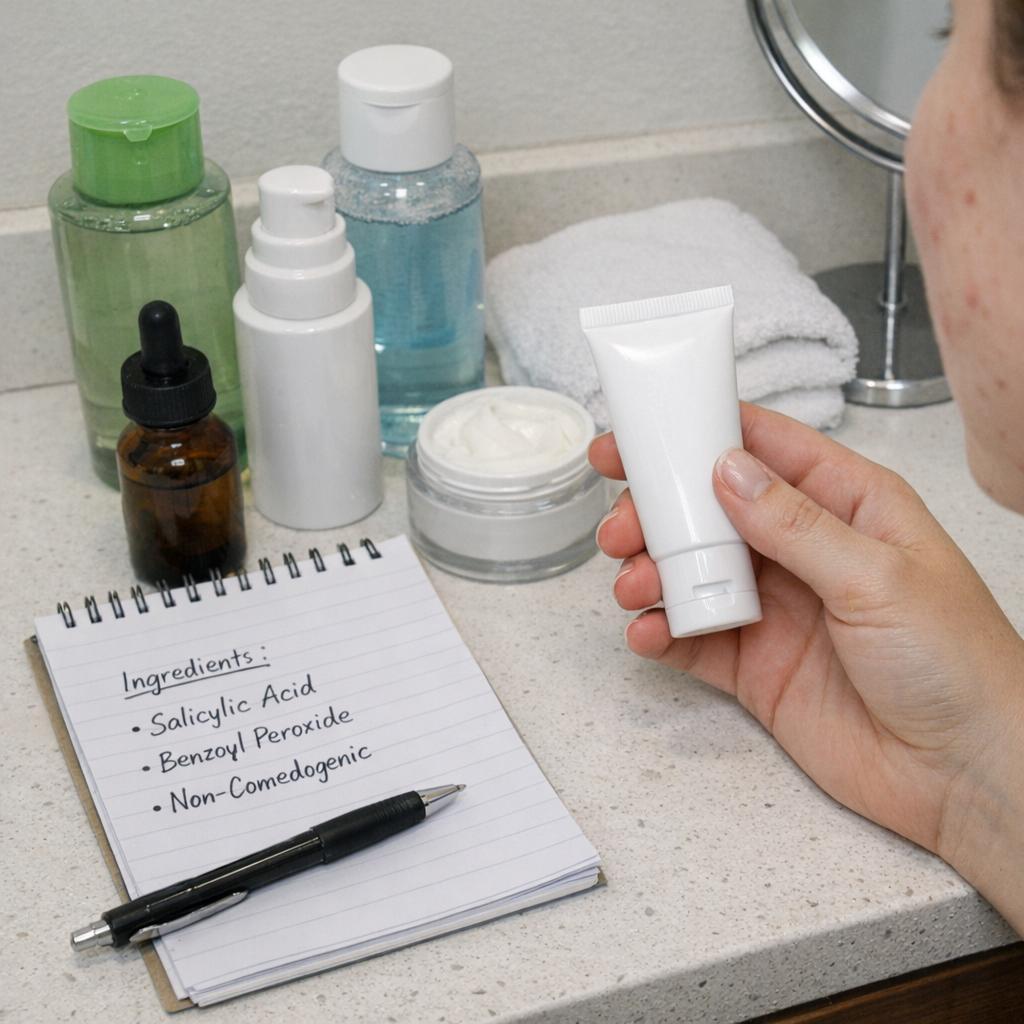
A useful routine for acne-prone skin is usually simple: a gentle cleanser, a comfortable non-comedogenic moisturizer, broad-spectrum sunscreen, and one targeted treatment chosen for the concern you want to address. Add products one at a time, follow the current label, and use the routine consistently before judging the results. Stronger formulas, more ingredients, and frequent switching can increase irritation without improving acne.
What should you look for first?
Start with the basics rather than buying several acne treatments at once. When each product has a clear role, it is easier to assess results and identify possible sources of irritation.
- Cleanser: Choose a gentle, non-abrasive formula that removes sunscreen, makeup, oil, and everyday buildup without leaving the skin tight or stinging.
- Moisturizer: Look for a non-comedogenic product, especially if rich textures have seemed to worsen congestion. The label is useful, but it does not guarantee that a product will suit everyone.
- Sunscreen: Choose broad-spectrum SPF 30 or higher in a texture you can apply generously and regularly. A lighter, fragrance-free formula may be easier to tolerate if your skin is easily irritated.
- One active treatment: Select an ingredient based on your main concern, then introduce it gradually according to the product label.
Avoid changing several products during the same week. If irritation or new bumps appear, you may not be able to identify which product contributed. A simple routine also makes dryness, burning, peeling, and redness easier to notice.
How do you read an acne-skincare label?
Marketing language does not tell the whole story. Read the active ingredient and directions first, then consider the complete formula and how it feels on your skin.
Useful label terms
- Non-comedogenic: The product has been formulated or tested with a lower likelihood of contributing to clogged pores. Testing methods and individual responses vary.
- Fragrance-free: This generally means the formula does not contain added fragrance. It may be a reasonable choice for skin that stings or becomes red easily. “Unscented” can mean masking ingredients are present, so the terms are not always interchangeable.
- Oil-free: This may suit people who dislike an oily finish, but the absence of oil does not automatically make a product non-comedogenic or less irritating.
- Active ingredient: This is the ingredient intended to provide the treatment effect. Check its name, concentration when listed, directions, warnings, and whether the product should be rinsed off or left on.
What should you not assume?
Terms such as “natural,” “clean,” “dermatologist tested,” and “for oily skin” do not establish that a product will prevent breakouts or suit sensitive skin. Essential oils and botanical extracts can still irritate. A product for oily skin may remove too much surface oil, while one marketed as gentle may contain an active ingredient that causes dryness.
Ingredient lists help with comparisons, but they cannot reliably predict an individual reaction. The complete formula, amount applied, frequency of use, other products in the routine, and the person’s skin all matter.
Which cleanser is appropriate for acne-prone skin?
A cleanser should remove sunscreen, makeup, excess oil, and buildup without making the rest of the routine harder to tolerate. A mild gel, lotion, or cream cleanser can work; the best texture depends on personal preference and how the skin feels after washing.
Choose a non-abrasive formula that rinses easily. Physical scrubs, rough cleansing tools, and vigorous rubbing can increase irritation. Strong foam does not prove that a cleanser works better, and a “squeaky” or tight feeling is not a necessary sign of cleanliness.
Some cleansers contain salicylic acid or benzoyl peroxide. These may suit certain breakout patterns, but they can be drying, particularly when combined with leave-on treatments. Follow the label rather than extending contact time or washing more frequently in an attempt to accelerate results.
How do you choose a moisturizer without worsening congestion?
Moisturizer can make acne treatment more comfortable, particularly when an active ingredient causes dryness. Skipping it is not a dependable way to prevent oiliness, and dry, irritated skin can make a routine difficult to continue.
Choose texture according to comfort:
- Lightweight lotion, gel-cream, or fluid: May suit someone who dislikes heavier finishes.
- Richer cream: May be more comfortable when the surrounding skin feels dry.
Ingredients such as glycerin, hyaluronic acid, and panthenol can provide hydration. Ceramides and other emollient ingredients may support a comfortable feel, but no single ingredient is necessary for everyone. Niacinamide appears in many moisturizers and may be well tolerated, although higher concentrations or particular formulas can cause stinging in some people.
Apply the product as directed and observe it over several uses. Persistent new bumps, itching, burning, or worsening redness are reasons to stop and reassess rather than add another product.
Which active ingredient matches the concern?
Acne treatments serve different purposes, and none is appropriate for everyone. Use the following as a product-comparison guide, not as a way to diagnose the cause or severity of breakouts.
| Ingredient | Often used for | Important considerations |
|---|---|---|
| Salicylic acid | Blackheads, whiteheads, and surface congestion | May cause dryness or irritation, especially in leave-on products or when combined with other exfoliating ingredients. |
| Benzoyl peroxide | Red, inflamed pimples and pustules | Can dry or irritate the skin and may bleach hair, towels, clothing, or bedding. Follow the product directions. |
| Adapalene | Clogged pores and recurring acne lesions | Can cause dryness, peeling, or irritation. Use only according to the label and seek professional guidance if you have questions about suitability. |
| Azelaic acid | Acne-related inflammation and uneven-looking marks | May sting or irritate at first. Strength and availability vary, so check the label. |
Salicylic acid or benzoyl peroxide?
Salicylic acid is often selected when clogged pores and congestion are the main concern. Benzoyl peroxide is often used when red, inflamed pimples are more prominent. A cleanser and a leave-on treatment containing the same active are not interchangeable because their contact times and directions differ.
Higher strength is not automatically better. A lower-strength product that is used consistently and tolerated well may be more practical than a stronger formula that causes burning or peeling. Concentrations, formulations, and local labeling vary, so follow the current package instructions.
Where does adapalene fit?
Adapalene is an over-the-counter topical retinoid in the United States. It is commonly used for acne involving clogged pores and recurring lesions. It can take time to show benefit and may irritate the skin during the adjustment period. Do not apply more than directed or assume that combining it with several other active ingredients will speed improvement.
Ask a qualified clinician or pharmacist about suitability if you are pregnant, trying to become pregnant, breastfeeding, using prescription treatment, managing significant eczema, concerned about medication interactions, or experiencing persistent irritation.
How can you introduce an active with less irritation?
Use one new active at a time. Read the label for the amount, frequency, application method, and warnings. A cautious introduction can make intolerance easier to identify, but there is no universal schedule for every skin type or product.
- Keep the cleanser, moisturizer, and sunscreen familiar and gentle.
- Apply a modest amount as directed rather than a thicker layer.
- Allow time to evaluate comfort and response before adding another treatment.
- If dryness or stinging develops, review the label and consider pausing the new nonprescription product. Seek advice if symptoms are persistent or severe.
Some treatment plans combine ingredients, but layering several potentially irritating products without guidance can increase peeling and discomfort. Be particularly cautious with combinations involving retinoids, exfoliating acids, benzoyl peroxide, scrubs, and strong astringents.
Does sunscreen matter when using acne products?
Daily broad-spectrum sunscreen helps limit ultraviolet exposure. It may also make acne-related dark marks less noticeable over time by limiting additional tanning. Some acne products can increase irritation or sensitivity to sunlight. Sunscreen does not treat the cause of acne, but it remains an important part of protecting exposed skin.
Choose SPF 30 or higher in a formula comfortable enough to use as directed. If one sunscreen stings, leaves an unwanted residue, or appears to contribute to congestion, try a different texture or formulation rather than skipping sun protection. Mineral and chemical filters can both be effective; tolerability and correct use are generally more useful selection criteria than choosing one category for everyone.
Which routine mistakes can make acne-prone skin harder to manage?
- Scrubbing or picking: Manipulating bumps can prolong inflammation and increase the chance of marks or scarring.
- Over-cleansing: Repeated washing or harsh cleansers can cause discomfort and make active treatments harder to tolerate.
- Starting several actives together: This increases possible sources of irritation and makes reactions difficult to trace.
- Switching too quickly: Many acne treatments require consistent use over weeks to assess. No immediate improvement does not necessarily mean a product will never help.
- Choosing by texture alone: A lightweight product is not automatically non-comedogenic, and a rich product is not automatically pore-clogging.
- Ignoring product warnings: Check directions covering the eye area, sun precautions, age restrictions, damaged skin, and storage.
Who should be cautious?
Use extra care before starting a new active if you have significant irritation, eczema, rosacea, very dry skin, a known ingredient allergy, or a current rash. Caution is also appropriate if you use prescription treatment because an additional nonprescription active may increase irritation or conflict with the treatment plan. Do not begin, stop, or change prescription medication based on this guide.
People who are pregnant, trying to become pregnant, or breastfeeding should ask a qualified healthcare professional about acne ingredients before use, especially retinoid products. Children and teenagers may need age-appropriate guidance from a parent, pharmacist, or clinician. Follow the current product label even when advice found elsewhere differs.
When should you seek professional advice?
- Breakouts are deep, very painful, widespread, or leaving scars.
- A consistent, label-directed nonprescription routine has not helped after a reasonable trial.
- You develop severe swelling, blistering, hives, facial swelling, trouble breathing, or rapidly worsening symptoms.
- Burning, cracking, intense redness, or peeling does not settle after stopping a suspected irritant.
- Breakouts begin suddenly with other changes, such as irregular menstrual cycles or increased facial hair.
- Skin concerns cause substantial distress, avoidance, sleep disruption, or difficulty with daily activities.
A dermatologist or other qualified healthcare professional can assess the pattern, consider causes that skincare products cannot address, and discuss prescription or procedural options when appropriate.
A practical way to decide
1. Define the main concern
Are you mainly noticing clogged pores, red inflamed pimples, irritation, or lingering dark marks? If you are unsure, describe what you see without trying to diagnose it.
2. Check the active and directions
Confirm the ingredient, concentration if listed, rinse-off or leave-on use, warnings, and recommended frequency.
3. Keep the basics steady
Continue a gentle cleanser, comfortable moisturizer, and broad-spectrum sunscreen while evaluating the targeted product.
4. Change one variable
Add one product at a time so that irritation and improvement are easier to interpret.
Before buying, ask:
- What concern is this product intended to address?
- Is another ingredient in my routine already serving the same role?
- Could the formula add fragrance, abrasion, or another potential irritant?
- Can I use it consistently according to its label?
These questions are usually more useful than choosing the strongest or most intense-sounding formula.
Frequently asked questions
Can moisturizer be used on acne-prone skin?
Yes. Moisturizer can make a routine more comfortable, especially when an acne treatment causes dryness. Choose a non-comedogenic product and monitor how your skin responds. Stop using it if it repeatedly causes itching, burning, worsening redness, or persistent new bumps.
Should salicylic acid and benzoyl peroxide be used together?
They can appear in the same overall treatment plan, but using both without guidance may increase dryness and irritation. Check each product’s directions, introduce only one new active at a time, and ask a pharmacist or clinician if you are uncertain about combining them.
How long should an acne product be given to work?
This depends on the ingredient, formulation, consistency of use, and concern being addressed. Acne treatment generally does not create an immediate change, and frequent switching can prevent a fair assessment. Seek professional advice if symptoms worsen or there is no meaningful improvement after consistent, label-directed use.
Are physical scrubs helpful for blackheads?
Scrubs may temporarily change how the skin’s surface feels, but they do not reliably address the processes that contribute to clogged pores. Rough particles and vigorous rubbing can irritate inflamed skin. A suitable active ingredient used according to its directions may be a less abrasive option.
What if every acne product seems irritating?
Review how many active ingredients you use, how frequently you apply them, and whether the cleanser or other basic products are also irritating. Do not add more treatments to compensate. Persistent burning, rash, swelling, or significant peeling warrants advice from a qualified healthcare professional.
A well-chosen acne routine is not necessarily the strongest or most complicated one. Gentle basics, careful label reading, one clear treatment goal, realistic expectations, and timely professional care provide a more practical path than continually adding products.
Sources and further reading
These resources provide general medical and regulatory context.
- Acne: Tips for managing — American Academy of Dermatology Association
- Acne clinical guideline — American Academy of Dermatology Association
- Adult acne treatment dermatologists recommend — American Academy of Dermatology Association
Safety note
This guide provides general education, not diagnosis or individualized treatment. Follow current product labels and seek qualified care for severe, persistent, painful, rapidly changing, or otherwise concerning symptoms.