
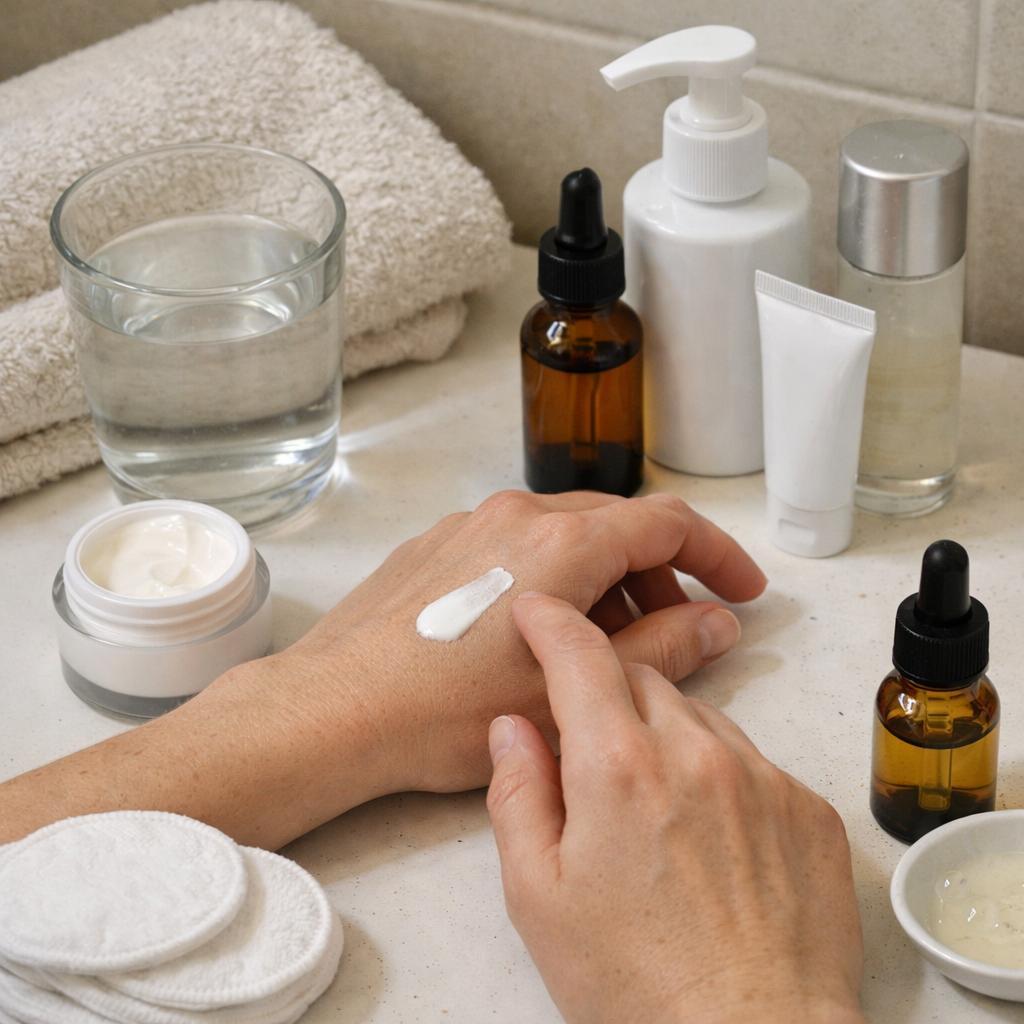
If your skin suddenly feels tight, stings when products are applied, or looks unusually dry or flushed, simplify your routine first. Cleanse gently only when needed, apply a bland moisturizer to slightly damp skin, use broad-spectrum sunscreen during the day, and pause nonessential actives and fragranced products. Symptoms alone cannot confirm that the skin barrier is the cause, so seek professional advice if discomfort is severe, persistent, spreading, or accompanied by swelling, oozing, or pain.
What should you do first when your skin feels irritated?
For mild, recent irritation, a short period of routine simplification is often a reasonable starting point. The goal is not to find a perfect “barrier repair” product. It is to reduce potential triggers while supporting the skin with gentle cleansing, moisturization, and sun protection.
A practical starting routine:
- Pause exfoliating acids, scrubs, retinoids, strong acne treatments, and fragranced products if they appear to worsen discomfort.
- Use lukewarm water and a mild, fragrance-free cleanser when cleansing is necessary.
- Apply a simple moisturizer your skin has previously tolerated, or choose one made for sensitive skin.
- Use broad-spectrum sunscreen as tolerated, supported by hats, shade, and other physical protection outdoors.
- Wait until your skin feels consistently comfortable before gradually reintroducing products.
Adjust this framework to your skin and environment. Some people need cleanser once daily, while others may prefer a water rinse at one time of day. A cream may feel better than a lotion in dry weather, while a lighter moisturizer may be more comfortable in humid conditions. Product labels, previous tolerance, and professional guidance should shape the details.
What is the skin barrier?
The skin barrier generally refers to the outermost part of the epidermis, especially the stratum corneum. It helps limit water loss and reduces the entry of substances that may irritate the skin. Its structure includes skin cells surrounded by lipids such as ceramides, cholesterol, and fatty acids. Natural moisturizing factors and the skin’s surface environment also contribute to how this outer layer functions.
Frequent washing, hot water, friction, dry air, cold wind, sun exposure, shaving, and irritating products can temporarily affect how this layer feels or behaves. Prescription and nonprescription treatments may also cause dryness or sensitivity as expected effects. Sometimes a combination of products is harder to tolerate than any one product used alone.
However, “damaged skin barrier” is not a diagnosis that can be confirmed from a mirror or symptom list. Tightness, flaking, redness, burning, bumps, and sensitivity can also occur with allergic or irritant reactions, eczema, rosacea, infection, sun injury, and other concerns requiring individualized care.
What can routine simplification tell you?
A simplified routine may help when recent product use, over-cleansing, environmental exposure, or friction appears to be contributing to mild discomfort. Improvement can suggest that one or more routine factors were irritating your skin. It does not prove that the skin barrier was the only issue, identify the exact trigger, or rule out an underlying condition.
No improvement does not mean you need more active ingredients. The trigger may still be present, the cause may not be primarily routine-related, or professional assessment may be useful. Avoid trying to diagnose the problem by matching one symptom to one explanation.
Keep a broad view: “Sensitive” describes how skin feels or reacts; it does not explain why. Persistent or recurrent symptoms deserve more attention than a brief, mild reaction after a new product.
How can you simplify cleansing?
Reduce heat and friction
Use lukewarm rather than hot water. Apply cleanser with clean fingertips, keep rubbing brief, and pat dry with a soft towel instead of scrubbing. Washcloths, cleansing brushes, facial sponges, and frequent wiping can add friction when skin already feels uncomfortable.
Choose a mild cleanser labeled for sensitive skin, or a fragrance-free option if fragrance has been a problem for you. Cream, lotion, oil, and low-foam formulas can all work; the best choice depends on your skin type, sunscreen or makeup use, and personal tolerance.
A cleanser does not need to leave skin feeling “squeaky clean.” Tightness after washing is a reason to reconsider the formula, water temperature, technique, or cleansing frequency.
How often should you cleanse?
There is no universal schedule. Cleanse when you need to remove sunscreen, makeup, sweat, or buildup. If your skin is comfortable after a morning water rinse, a second cleanser may not be necessary then. If you wear water-resistant sunscreen or makeup, follow the product’s removal directions rather than repeatedly washing to compensate for an ineffective technique.
What kind of moisturizer may help?
Moisturizers reduce water loss and can make dry or uncomfortable skin feel more flexible. Choose a formula your skin tolerates and that suits your climate and preferences. Creams and ointments are generally more occlusive than lotions. Gels and lightweight lotions may feel less heavy but may not provide enough comfort for very dry skin.
| Moisturizer component | Examples | General role |
|---|---|---|
| Humectants | Glycerin, hyaluronic acid | Help attract and retain water. |
| Emollients | Ingredients that soften the skin surface | Help skin feel smoother and more flexible. |
| Occlusives | Petrolatum, dimethicone | Help reduce water loss. |
| Barrier-supporting ingredients | Ceramides, panthenol, colloidal oatmeal, squalane | May be included in products intended for dry or sensitive skin. |
No ingredient guarantees a particular result, and a longer ingredient list is not automatically better. Apply moisturizer after cleansing while skin is slightly damp if that feels comfortable. Reapply as needed, especially after handwashing or exposure to cold, dry air.
If a moisturizer causes significant burning, increasing redness, or consistently worsening symptoms, wash it off and stop using it. A product marketed for barrier support can still be unsuitable for your skin.
Which products are reasonable to pause?
When skin is stinging or unusually reactive, nonessential actives can make it harder to identify what is helping. Consider pausing the following, particularly if discomfort began after adding them, increasing their strength, or using them more often:
| Product or practice | Why a pause may help | What to consider later |
|---|---|---|
| Exfoliating acids such as glycolic, lactic, or salicylic acid | They can cause dryness, stinging, or irritation, especially with frequent use or when combined with other actives. | Reintroduction depends on comfort, the product label, and the reason for using it. |
| Retinoids and retinol products | Dryness and irritation may occur after starting, increasing strength, or using the product too often. | Use prescription products according to the prescribing clinician’s directions. |
| Strong vitamin C formulas | Some low-pH formulas may sting sensitive skin. | A different formula or lower frequency may be better tolerated after skin is stable. |
| Scrubs, brushes, and peeling products | Mechanical or intensive exfoliation adds friction and may worsen discomfort. | There is no need to substitute another exfoliant during recovery. |
| Fragrance, essential oils, and heavily perfumed products | They can irritate some people or contribute to contact reactions. | Fragrance-free options may simplify the routine if sensitivity recurs. |
Do not stop a prescribed treatment without contacting the clinician who prescribed it. The appropriate next step may be to continue, adjust, or temporarily change the treatment based on the condition being treated and the severity of side effects.
How does sunscreen fit into a simplified routine?
Sun exposure can worsen redness, dryness, and discomfort, and ultraviolet exposure occurs even in cool or cloudy weather. Use a broad-spectrum sunscreen with the sun protection factor listed on the label and apply it as directed. Mineral and organic sunscreen filters are both legitimate options; the practical choice is a formula you can tolerate and use consistently.
If sunscreen stings, avoid forceful rubbing and consider a different formula, applying it over moisturizer, or relying more on protective clothing while skin is irritated. Hats, sunglasses, shade, and avoiding intense midday exposure can reduce reliance on a product that currently feels uncomfortable. Follow the label’s reapplication directions, especially after swimming, sweating, or towel drying.
How long might improvement take?
There is no dependable universal timeline. Mild irritation may settle after the trigger is removed, while recurring or more significant symptoms may continue without targeted treatment. Improvement can be gradual. Less stinging or tightness may be noticeable before skin texture looks different.
Track trends instead of repeatedly checking your skin. A short note about new products, cleansing habits, weather, and symptoms may help reveal patterns. Avoid adding several “repair” products at once because improvement or worsening will be difficult to connect to any one change.
If symptoms are not clearly improving after a reasonable period of gentle care, professional assessment is more useful than continued trial and error.
Who should be especially cautious?
Extra caution is appropriate if you have a diagnosed skin condition, a history of product allergies, frequent facial flushing, recurrent rashes, very reactive skin, or a prescribed treatment that causes dryness. Children, pregnant or breastfeeding people, and people taking medications that affect the skin should ask a qualified clinician or pharmacist about ingredient and treatment questions rather than relying on a general routine.
Be cautious with “natural” and DIY remedies. Essential oils, undiluted acids, food-based masks, baking soda, abrasive powders, and occlusive mixtures can irritate skin or trigger a reaction. Patch testing a new product on a small area may reduce, but cannot eliminate, the chance of a broader reaction. Follow product directions and stop if concerning symptoms develop.
Stop and seek professional advice if
- Burning, pain, itching, or redness is severe, spreading, or getting worse.
- You develop facial swelling, hives, blistering, marked warmth, pus, oozing, or open sores.
- Symptoms involve the eyes, lips, mouth, or breathing, or swelling develops quickly. Seek urgent care for breathing difficulty or significant swelling.
- A rash repeatedly returns, affects areas beyond the face, or does not improve with gentle care.
- Dryness, cracking, or irritation interferes with sleep, work, or normal activities.
- You are unsure whether a prescription treatment should be continued or changed.
A clinician can evaluate the pattern, review exposures and medications, and determine whether testing or condition-specific care is appropriate. This matters because a routine designed for dryness may not address allergy, eczema, infection, or another source of inflammation.
A practical four-step reset
1. Review what changed
Think back over the previous several days or weeks. Note new products, increased frequency, hair products touching the face, shaving, masks, weather changes, sun exposure, and changes in cleansing. Do not assume the newest product is automatically responsible; irritation can result from repeated exposure or combinations of products.
2. Remove nonessential variables
Keep the routine as short as practical: gentle cleansing when needed, moisturizer, and sun protection as tolerated. Pause optional actives and abrasive tools. Discuss prescribed treatments with the prescriber instead of changing medication independently.
3. Observe comfort and function
Notice whether cleansing and moisturizing feel more comfortable, dryness becomes less distracting, and symptoms remain stable rather than spreading. These observations are more useful than expecting a specific result within a fixed number of days.
4. Add products back slowly
Once skin has been consistently comfortable, decide whether each paused product is still necessary. Add no more than one nonessential product at a time, use it according to its label, and allow enough time to assess tolerance before making another change. The appropriate interval depends on the product, the person, and why it is being used.
How can you reduce future irritation?
- Introduce new products one at a time when possible.
- Avoid increasing several active ingredients at once.
- Use the lowest frequency that serves your goal, especially when starting an exfoliant or retinoid.
- Protect skin from strong sun, cold wind, and very dry air.
- Moisturize dry areas instead of automatically adding another treatment product.
- Follow product labels and professional instructions for prescribed or condition-specific treatments.
If a treatment is helping a diagnosed condition, the solution may be a clinician-guided adjustment rather than stopping it. If irritation keeps returning, identifying an allergy or addressing an underlying condition may be more useful than buying additional products.
Frequently asked questions
Can you tell if your skin barrier is damaged by looking at it?
No. Tightness, dryness, flaking, redness, burning, and sensitivity can be consistent with irritation, but they do not identify one cause. Similar symptoms occur with several skin conditions and reactions. A simplified routine may be reasonable for mild, recent discomfort, while persistent or severe symptoms warrant professional assessment.
Should you stop every skincare product?
Not necessarily. Pause nonessential products that may be irritating, especially recently added actives, scrubs, and fragranced formulas. Continue gentle products you know you tolerate. Do not stop a prescription treatment without asking the prescribing clinician how to proceed.
Are ceramides required for skin-barrier support?
No single ingredient is required for everyone. Ceramides are commonly included in moisturizers intended to support the outer skin layer, but a simple moisturizer containing humectants, emollients, or occlusives may also be useful. Tolerance, consistency, and the rest of the routine matter.
When can you restart exfoliants or retinoids?
There is no universal restart date. Wait until your skin is consistently comfortable, then decide whether the product is necessary and follow its label or prescribing instructions. Reintroduce only one nonessential active at a time, and stop or seek advice if significant irritation returns.
What if a moisturizer stings?
Wash it off if the discomfort is significant or continues. Check whether the product contains fragrance, exfoliating acids, or other ingredients you may not tolerate. If many products sting, symptoms persist, or swelling or blistering occurs, seek professional advice rather than repeatedly testing new products.
Supporting the skin’s outer layer usually starts with fewer variables, gentle handling, adequate moisturization, and sun protection—not a more complicated routine. This is general education rather than diagnosis or individualized treatment; pay attention to the direction and severity of symptoms and seek qualified care when the pattern is unclear or not improving.
Sources and further reading
These resources provide general medical and product-care context.
- How to relieve dry skin — American Academy of Dermatology Association
- Skin care basics — American Academy of Dermatology Association
- How to test skin care products — American Academy of Dermatology Association