
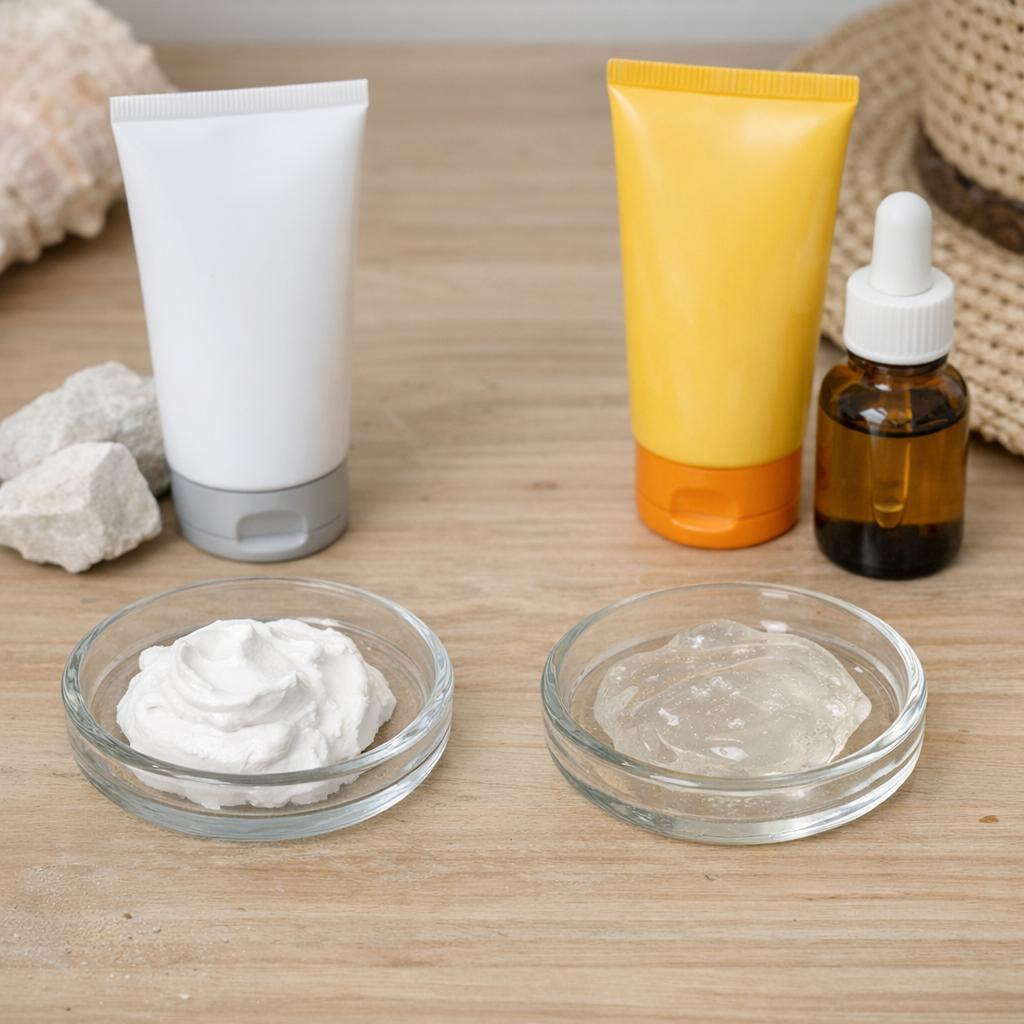
Practical answer: Neither mineral nor chemical sunscreen is universally better. Choose a broad-spectrum product with SPF 30 or higher that you can apply generously, tolerate comfortably, and reapply during continued exposure. Mineral formulas may suit people who experience stinging with some sunscreens or prefer zinc oxide or titanium dioxide. Chemical formulas often offer lighter textures and easier blending. The complete formula—and whether you will use it consistently—matters more than the category alone.
What is the difference between mineral and chemical sunscreen?
In the United States, sunscreen active ingredients are commonly grouped into two categories. Mineral sunscreens, also called inorganic or physical sunscreens, use zinc oxide, titanium dioxide, or both. Chemical sunscreens, also called organic-filter sunscreens, use other UV filters, such as avobenzone, octisalate, octocrylene, homosalate, or octinoxate, depending on the product.
These names describe the active filters, not the product’s quality. Both types can absorb ultraviolet radiation. Mineral filters can also reflect and scatter some UV, although absorption remains an important part of how modern mineral formulas work. Chemical filters absorb UV and convert its energy into a small amount of heat released from the skin.
Performance also depends on the combination and concentration of filters, formula stability, film-forming ingredients, packaging, and water-resistance testing. An elegant sunscreen applied too sparingly may provide less real-world protection than a heavier product used in the labeled amount.
Which type provides better protection?
Start with the broad-spectrum label, which indicates protection against both UVA and UVB radiation. UVB is strongly associated with sunburn, while UVA contributes to cumulative skin damage, uneven pigmentation, and premature visible changes. SPF primarily reflects protection against UVB-related sunburn, so a high SPF does not replace broad-spectrum coverage.
For many adults, broad-spectrum SPF 30 or higher is a reasonable starting point. Higher SPF products may provide more protection under test conditions, but they do not justify applying less, staying outside longer, or skipping reapplication. SPF 50 is not twice as protective as SPF 25, and no sunscreen blocks all UV radiation.
Mineral and chemical sunscreens can both be effective when they meet applicable requirements and are used as directed. Claims that mineral sunscreen is automatically safer—or that chemical sunscreen is automatically harmful—overlook differences among ingredients, formulations, exposure conditions, and individual tolerance.
| Consideration | Mineral sunscreen | Chemical sunscreen |
|---|---|---|
| Common active filters | Zinc oxide, titanium dioxide, or both | Other approved UV filters, alone or in combinations |
| Protection | Can provide broad-spectrum protection when labeled broad spectrum | Can provide broad-spectrum protection when labeled broad spectrum |
| Texture | May feel creamier, thicker, or more noticeable, although lightweight fluids are available | Often lightweight, transparent, and easy to layer under makeup |
| White cast | May be visible, particularly in untinted formulas; tint can improve blending | Usually leaves little or no white cast, depending on the formula |
| Eye comfort | May be more comfortable for some people, although any sunscreen can irritate the eyes | Some formulas may sting, especially with sweating or watery eyes |
| Water resistance | Available in some products; confirm on the label | Available in some products; confirm on the label |
Which formula may suit your skin and routine?
Skin type is only one part of the decision. Texture, fragrance, preservatives, supporting ingredients, climate, makeup use, and the current condition of your skin can be just as important.
If sunscreen often stings
A mineral sunscreen containing zinc oxide or titanium dioxide may be worth trying if other formulas sting, particularly around the eyes. However, mineral does not mean irritation-free. Fragrance, botanical extracts, alcohol, preservatives, and the product base can also affect comfort.
Avoid applying sunscreen directly into the eyes. If a product repeatedly causes burning, redness, or discomfort, switch formulas rather than assuming irritation is necessary for protection. Persistent or significant symptoms warrant professional advice.
For oily or blemish-prone skin
Texture and the overall formula often matter more than the filter category. Lightweight fluids, gels, or lotions may feel more comfortable than rich creams. Labels such as “oil-free” or “non-comedogenic” can be useful starting points, but they cannot predict every individual response.
Chemical sunscreens are often easy to spread in a thin, even layer, while lightweight and tinted mineral fluids are also available. If your skin is sensitive to multiple products, a sunscreen without unnecessary extras such as fragrance may be more practical. Introduce new products one at a time when possible so that a reaction is easier to identify.
For dry skin
A moisturizing sunscreen may reduce the need for a separate morning moisturizer. Glycerin, ceramides, and other humectants or emollients can improve the feel of either sunscreen category. A cream-based mineral formula may feel comfortable, while a hydrating chemical sunscreen may layer more easily under makeup.
Choose according to how the product behaves on your skin. Consider whether it pills, emphasizes flakes, or remains comfortable after application. Moisturizer underneath may help, although several layered products can increase pilling.
For deeper skin tones or visible white cast
Untinted mineral sunscreens may leave a white, gray, or purple cast on some skin tones. Although this is cosmetic, it can reduce protection if it leads to sparse application or abandoned use. Tinted mineral formulas may blend more naturally. Many contain iron oxides, which may also provide some protection against visible light. Visible light can contribute to uneven pigmentation in some people, but tint does not replace broad-spectrum SPF.
Chemical formulas are often less visible, although the final finish still varies. Testing a small amount along the jawline can help you assess color, sheen, pilling, and comfort before committing to a full-size product.
For sweat, swimming, or sports
Choose a product specifically labeled water resistant for swimming or heavy sweating. In the United States, the label generally states whether protection lasts for 40 or 80 minutes while swimming or sweating. No sunscreen is waterproof. Reapply after the labeled period, towel drying, or extended sweating.
Both mineral and chemical sunscreens can be water-resistant. Chemical formulas may spread more easily over large areas, while some mineral products may feel thicker. For outdoor activity, prioritize even coverage and a texture you can comfortably reapply.
How should sunscreen be applied?
Application technique can matter more than filter category. Follow the current product label because directions can vary by product and region.
- Choose broad-spectrum SPF 30 or higher. For extended outdoor exposure, look for water resistance and note the stated duration.
- Apply enough. A commonly used adult guide for the face and neck is about two finger lengths, or enough to cover the area generously. The exact amount varies with hand size and the area covered. A tiny pea-sized dab is unlikely to be enough.
- Cover commonly missed areas. Include the ears, hairline, neck, lips with a suitable lip product, and backs of the hands. Use care around the eyelids and avoid direct eye contact.
- Apply before exposure. Allow the sunscreen to form an even film according to its label. Mineral sunscreen still requires careful application and appropriate sun precautions.
- Reapply during continued exposure. Follow the label and reapply after swimming, sweating, or towel drying. Approximately every two hours is a common outdoor guide, but conditions and product directions matter.
Makeup with SPF may contribute to protection, but most people do not apply enough foundation, concealer, or powder to reach the labeled SPF. A dedicated sunscreen underneath makeup is generally more dependable. Lotions, sticks, sprays, or powders may help with reapplication, but convenient formats can still leave gaps. Do not assume a quick pass with a stick or powder provides complete coverage.
How can you try a new sunscreen cautiously?
Test a small amount on the inner forearm or along the jawline, following the product directions and avoiding broken skin. This may reveal obvious irritation, but it cannot guarantee facial comfort or rule out a delayed reaction.
Next, try the sunscreen on a limited facial area before applying it everywhere. Introduce one new product at a time when possible. Stop using the product if significant discomfort develops. Repeated burning, swelling, rash-like changes, or worsening symptoms require more caution than an unappealing texture or finish.
What a sunscreen comparison cannot predict
The mineral-versus-chemical distinction cannot identify the cause of a reaction or predict the best product for every person. Mineral does not mean irritation-proof, and chemical does not mean unsafe. Comfort depends on the specific filters and the complete formulation.
Protection also cannot be judged from texture alone. A lightweight sunscreen can work well when applied in the correct amount, while a thick product may provide inadequate protection if spread too thinly. High SPF cannot compensate for missed areas, insufficient quantity, or skipped reapplication.
Who should use extra care?
Be cautious when selecting or testing sunscreen if you have a history of reactions to personal-care products, significant eye sensitivity, or skin that is irritated, peeling, cracked, or recently treated. If you have a known ingredient allergy, review the complete ingredient list and ask a qualified health professional or pharmacist for help interpreting it.
Infants and children may need products selected according to age, the current label, and guidance from a pediatric health professional. Shade, protective clothing, hats, and avoiding intense midday exposure remain important parts of sun protection.
If you use prescription skin treatments, follow the prescribing professional’s instructions. Do not start, stop, or change a prescription based on a sunscreen comparison. A pharmacist or clinician can address questions about timing, irritation, or interactions.
Stop using the product and seek advice if
- You develop facial swelling, hives, blistering, severe burning, trouble breathing, or symptoms involving the eyes.
- A rash, redness, itching, or swelling persists after the sunscreen is washed off or returns with repeated use.
- Your eyes remain painful, very red, light-sensitive, or affected in vision after sunscreen exposure.
- Sunburn is severe, covers a large area, blisters extensively, or occurs with fever, vomiting, confusion, or dehydration.
- You are unsure what to use after a procedure, during a flare of an existing skin condition, or while using prescription treatment.
Breathing difficulty or swelling of the lips or tongue requires immediate medical attention.
A practical decision guide
- Start with the exposure. For daily errands, commuting, or time near windows, choose a sunscreen you can wear comfortably. For swimming or prolonged outdoor activity, prioritize a clearly labeled water-resistant formula.
- Confirm the essentials. Look for broad-spectrum protection and SPF 30 or higher. Check the expiration date, application directions, and water-resistance duration.
- Match the texture to your routine. Consider a fluid or gel if you avoid rich products, a moisturizing cream for dryness, or a tinted formula if white cast would discourage regular use.
- Account for tolerance. If sunscreens often sting, a fragrance-free mineral option may be a reasonable trial. If mineral formulas feel heavy or leave a cast, consider a chemical sunscreen or tinted mineral formula.
- Plan for reapplication. Choose packaging and texture that make generous application and reapplication realistic. A suitable sunscreen used consistently is more useful than an ideal formula left untouched.
Bottom line: Choose broad-spectrum SPF 30 or higher in a formula you will apply generously and reapply. Combine it with shade, sun-protective clothing, and a hat during prolonged exposure.
Frequently asked questions
Is mineral sunscreen safer than chemical sunscreen?
Not automatically. Both categories can provide effective broad-spectrum protection when formulated, labeled, and used correctly. Some people tolerate mineral filters better, while others prefer the texture of chemical formulas. Safety and comfort depend on the specific product and individual tolerance.
Does mineral sunscreen need to be reapplied?
Yes. Mineral sunscreen is not a once-daily shield. Reapply according to the label and after swimming, sweating, or towel drying. During extended outdoor exposure, approximately every two hours is a common guide, although conditions and product directions should determine timing.
Can chemical sunscreen cause skin irritation?
Some chemical formulas can irritate certain people, just as mineral sunscreens and other cosmetic ingredients can. Stinging may be more noticeable around the eyes or on already sensitive skin. Stop using a product that repeatedly causes discomfort and seek advice if symptoms persist or are severe.
Is SPF 50 much better than SPF 30?
SPF 50 may provide somewhat more protection under test conditions, but it does not remove the need for broad-spectrum coverage, generous application, complete coverage, and reapplication. A higher SPF does not justify longer exposure.
Can tinted mineral sunscreen reduce white cast?
Often, yes. Tint can help mineral formulas blend more naturally across a wider range of skin tones. Products containing iron oxides may also offer some additional protection from visible light. The tint does not replace broad-spectrum SPF, and the sunscreen still needs to be applied generously.
Sources and further reading
These resources provide general medical and regulatory context.
- Sunscreen FAQs — American Academy of Dermatology Association
- How to select a sunscreen — American Academy of Dermatology Association
- Sunscreen: How to Help Protect Your Skin from the Sun — U.S. Food and Drug Administration
Safety note
This guide provides general education rather than diagnosis or individualized treatment. Follow the current product label and seek qualified care for severe, persistent, painful, or otherwise concerning reactions.