
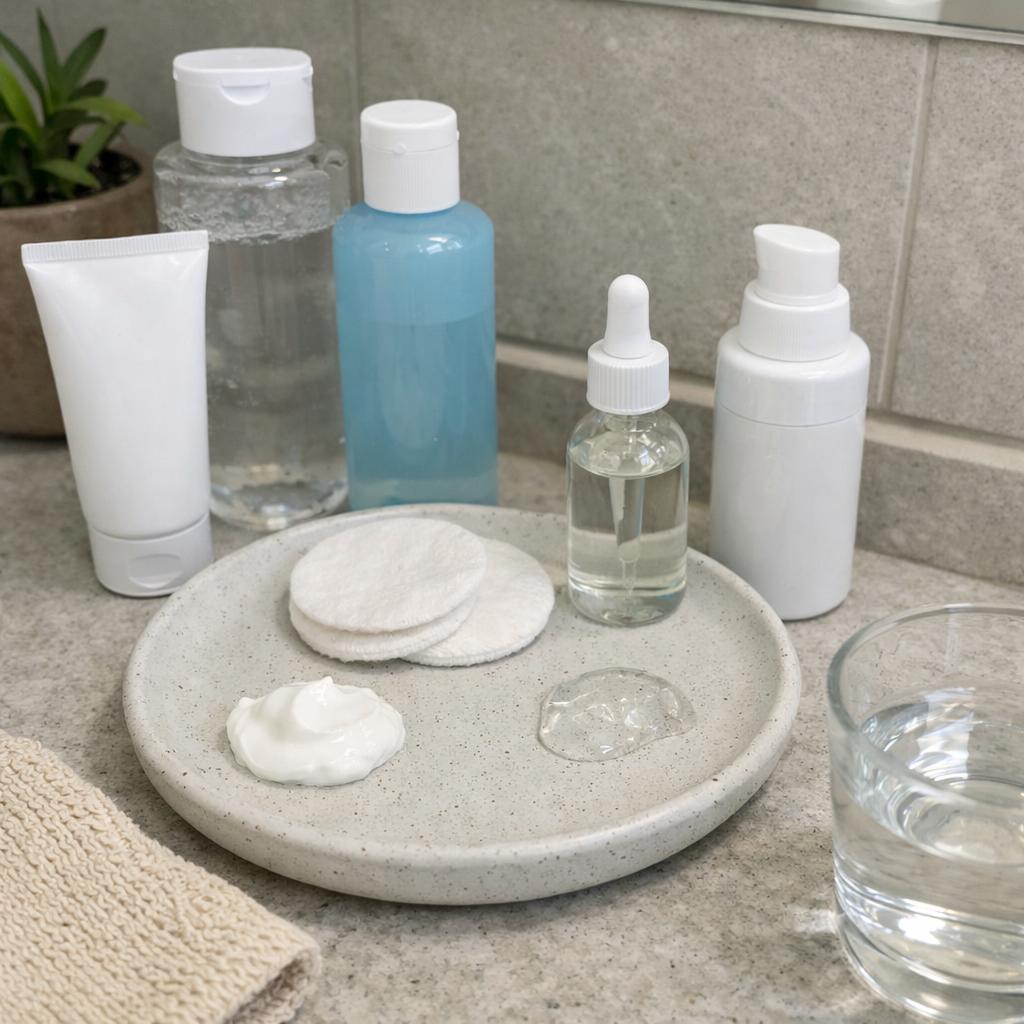
A simple morning routine for sensitive skin usually comes down to three decisions: whether to cleanse, whether to moisturize, and which broad-spectrum sunscreen feels comfortable enough to use consistently. Start with lukewarm water or a gentle fragrance-free cleanser, add a basic moisturizer if needed, and finish with sunscreen according to the product label. Introduce new products one at a time and stop using anything that causes persistent burning, itching, swelling, or a worsening rash.
What is the simplest useful morning routine?
For many people with easily irritated skin, a practical starting routine is:
- Cleanse only as needed. Rinse with lukewarm water if your skin feels comfortable, or use a gentle cleanser to remove residue, oil, or sweat.
- Moisturize if needed. Apply a straightforward, fragrance-free formula if your skin feels dry, tight, rough, or uncomfortable.
- Apply broad-spectrum sunscreen. Choose SPF 30 or higher, follow the label directions, and reapply as directed while exposure continues.
Sensitive skin is not a single diagnosis. It is a broad description for skin that is prone to stinging, burning, redness, dryness, itching, or discomfort. The aim of a minimal routine is to reduce avoidable irritation while keeping the essential step of sun protection.
Do you need to cleanse in the morning?
Not necessarily. If you washed at night and your skin feels comfortable when you wake up, a lukewarm-water rinse may be enough. A cleanser may be useful if you applied a heavy nighttime product, became sweaty during sleep, or have oil or residue you want to remove.
Pay attention to how your skin feels after washing and later in the day. A tight or “squeaky clean” feeling does not mean a cleanser worked better; it may indicate that the formula, washing frequency, or water temperature is too drying for your skin.
How should you choose a gentle cleanser?
Look for a fragrance-free cleanser formulated for dry, sensitive, or easily irritated skin. Cream, lotion, and low-foaming textures may feel more comfortable than strongly foaming products, although texture alone cannot predict tolerability.
Ingredients such as glycerin, panthenol, and mild cleansing agents may support a more comfortable wash. Ceramides also appear in some cleansers, but because cleanser is rinsed away, its role differs from that of a leave-on moisturizer. Consider the full formula rather than choosing a cleanser solely for one popular “soothing” ingredient.
Both natural and synthetic fragrance materials can irritate some people or contribute to allergic contact dermatitis. “Unscented” may mean that an odor has been masked, while “fragrance-free” more clearly indicates that fragrance was not added. Neither term guarantees that a product will suit your skin.
What should a sensitive-skin moisturizer contain?
A morning moisturizer can reduce dryness and make sunscreen more comfortable, but a separate layer is not always necessary. If your sunscreen already feels moisturizing and your skin remains comfortable, you may be able to skip moisturizer. If your skin feels tight, rough, or dry, add one before sunscreen.
Instead of looking for one perfect ingredient, consider a formula that combines helpful ingredient categories:
Humectants
Glycerin, hyaluronic acid, and panthenol help attract or hold water in the outer layers of skin. They may feel more comfortable when paired with emollient or occlusive ingredients.
Emollients
Squalane, fatty alcohols, shea butter, and some plant oils can soften rough-feeling skin by filling spaces between skin cells.
Barrier-supporting ingredients
Ceramides, cholesterol, and fatty acids are used in some moisturizers to support the skin’s outer protective function. The effect depends on the complete formula and your response to it.
Soothing ingredients
Colloidal oatmeal, allantoin, and certain forms of panthenol are included in products intended to comfort dry or irritated-feeling skin. Even familiar ingredients can bother some people.
A short ingredient list may make troubleshooting easier, but “simple” does not automatically mean safe. A longer formula may work well for one person, while a minimalist product may still cause a reaction in another. Choose a texture that spreads without tugging and does not leave your skin excessively greasy, dry, or uncomfortable.
Should you apply moisturizer to damp skin?
Applying moisturizer after a gentle rinse while the skin is slightly damp may make it easier to spread and help reduce water loss. Exact timing is not essential. If applying a product to damp skin causes stinging, let your face dry before using it.
How do you choose sunscreen when products sting?
Choose a broad-spectrum sunscreen with SPF 30 or higher and use it according to the package directions. Sunscreen selection often involves tradeoffs: one product may feel comfortable but leave a visible cast, while another may look more transparent but sting around the eyes.
Mineral sunscreens use zinc oxide, titanium dioxide, or both as active ingredients. They may be a useful starting point for people who experience stinging with some organic-filter sunscreens, sometimes called chemical sunscreens. However, mineral formulas are not automatically irritation-free, and some people tolerate organic filters better.
| Choice | Potential advantages | Possible tradeoffs |
|---|---|---|
| Mineral sunscreen | May suit people who notice stinging with some other formulas; zinc oxide provides broad-spectrum protection. | Can leave a white or gray cast, feel heavier, or require more rubbing unless it spreads easily. |
| Organic-filter sunscreen | Often available in lightweight, transparent, or cosmetically elegant textures. | Some formulas may sting, particularly around the eyes or on already irritated skin. |
| Tinted sunscreen | May reduce visible cast and provide a more even-looking finish. | Available shades may not match every skin tone or preference. |
Apply enough sunscreen to cover exposed skin, including the face, ears, and neck when exposed. About two finger-lengths is a commonly used estimate for the face and neck, but follow the product’s directions and account for the area being covered. Using too little reduces the protection represented by the SPF label.
Reapply according to the label, particularly after swimming, sweating, toweling off, or prolonged outdoor exposure. Hats, shade, and protective clothing provide additional protection.
If sunscreen repeatedly burns or stings, change one variable at a time: filter type, fragrance status, texture, or whether you are applying it to already irritated skin. A reaction by itself does not prove that a particular ingredient is responsible.
Which ingredients and steps may be worth leaving out at first?
A minimal routine does not require avoiding every active ingredient forever. It limits variables while you learn what your skin tolerates. When establishing your routine, consider leaving out:
- Fragrance and essential oils: These can irritate or sensitize some people, including when they appear in products marketed as natural.
- Exfoliating acids and scrubs: Glycolic, lactic, salicylic, and other exfoliating products may increase dryness or stinging when overused or applied to uncomfortable skin.
- Concentrated active products: Low-pH L-ascorbic acid vitamin C formulas, retinoids, and some acne treatments can be useful for specific concerns but may cause irritation.
- Several new products at once: Introducing multiple formulas together makes it difficult to identify which one caused a problem.
Do not stop a prescribed treatment or change a medical regimen based on general skincare guidance. Ask the clinician managing that treatment how to address irritation or combine it with your morning routine.
How should you patch test a new product?
An at-home patch test may reduce the chance of applying an unsuitable product over your entire face, although it cannot predict every reaction. It is particularly useful for leave-on products such as moisturizers and sunscreens.
- Read the label. Check the directions, warnings, and ingredient list when available.
- Choose a small area. Apply a small amount to the inner forearm or along the jawline. Do not test near the eyes or on broken skin.
- Repeat cautiously. Follow the product’s testing directions, or use the same limited area over several days if no method is provided.
- Watch for changes. Look for immediate discomfort and delayed itching, swelling, rash, or persistent redness.
- Expand gradually. If the test area remains comfortable, introduce the product to a small facial area before applying it more broadly.
If the product causes a reaction, wash it off and stop using it. A home patch test is not the same as formal allergy testing, and tolerability can change with application amount, frequency, other products, sun exposure, or the condition of your skin.
What can a simple routine tell you?
A consistent routine can help you notice which products and habits appear to increase discomfort. Reducing unnecessary cleansing, friction, fragrance exposure, and unprotected sun exposure may also improve day-to-day comfort.
However, the routine cannot determine whether redness or irritation is caused by rosacea, eczema, contact dermatitis, acne, an allergy, or another condition. Stinging may reflect irritation, dryness, an allergic reaction, an underlying skin condition, or several factors at once.
Labels such as “sensitive skin,” “natural,” “clean,” “hypoallergenic,” and “dermatologist tested” do not guarantee that a formula will be tolerated. Treat them as product descriptions rather than proof of safety or effectiveness.
Who should be especially cautious?
Use extra care when introducing products if you have a history of cosmetic reactions, frequent facial flushing, persistent scaling, open or cracked skin, or discomfort that continues after simplifying your routine. People using prescription treatments, undergoing procedures, or managing a diagnosed skin condition should ask a qualified medical professional how to fit skincare around that care.
Avoid experimenting with multiple strong exfoliants, concentrated active ingredients, fragranced products, or other potential irritants while your skin is already burning, itching, cracked, or visibly inflamed.
Stop and seek professional advice if
- You develop facial swelling, hives, blistering, significant pain, or trouble breathing. Trouble breathing or rapidly developing swelling requires urgent medical attention.
- A rash spreads, oozes, crusts, or becomes increasingly painful.
- Burning, itching, redness, or scaling persists after you stop using the suspected product.
- Your eyes or lips become swollen, or the skin around your eyes is significantly affected.
- You repeatedly react to products or cannot find a routine that feels tolerable.
- A new or changing skin symptom affects sleep, work, or daily activities.
A qualified clinician can assess persistent or severe symptoms and discuss whether testing, treatment, or a different skincare approach is appropriate. Avoid adding more products simply to cover up an ongoing problem.
A practical morning decision guide
| If your skin feels like this | Try this approach |
|---|---|
| Comfortable, with no noticeable residue or sweat | Rinse with lukewarm water, then apply sunscreen. |
| Oily, sweaty, or coated with a nighttime product | Use a gentle fragrance-free cleanser before the rest of your routine. |
| Dry, tight, or rough after rinsing | Apply a fragrance-free moisturizer before sunscreen. |
| Comfortable with a moisturizing sunscreen | Consider skipping a separate moisturizer. |
| Prone to sunscreen stinging | Patch test a different formula and change only one feature at a time. |
- Begin with the basic three steps. Cleanse only when needed, moisturize according to comfort, and use broad-spectrum SPF 30 or higher.
- Test before committing. Patch test new products and introduce one new leave-on formula at a time.
- Keep brief notes if reactions are confusing. Record the product, application area, timing, and symptoms to help identify patterns.
- Do not chase a deadline. A routine that feels comfortable and protects exposed skin is useful even if it does not address every concern involving redness, acne, pigmentation, or texture.
Once the routine feels predictable, decide whether another product is needed for a specific goal. Add one change at a time and follow its label. Every extra step introduces another potential source of irritation and makes troubleshooting more difficult.
Frequently asked questions
Is fragrance-free sunscreen always best for sensitive skin?
Fragrance-free sunscreen is a sensible starting point because fragrance can irritate or sensitize some people. It is not a guarantee of comfort. Sunscreen filters, preservatives, alcohol, texture, and the current condition of your skin can also affect tolerability.
Can sensitive skin use chemical sunscreen?
Yes. Some people with sensitive skin comfortably use organic-filter sunscreens, commonly called chemical sunscreens. Others find certain mineral formulas less likely to sting. Tolerability depends on the complete formula, application area, and individual response.
Should you use vitamin C or niacinamide in the morning?
Neither is required for a basic morning routine. Niacinamide and some vitamin C products may suit certain people, but irritation depends on the ingredient form, concentration, formula, and frequency. Establish a comfortable cleanser, moisturizer, and sunscreen routine before considering one addition at a time.
How long should you patch test a skincare product?
Follow the product’s instructions when they include a testing method. Otherwise, testing a small area over several days may reveal immediate or delayed irritation, but it cannot rule out every possible reaction. Stop if the area becomes uncomfortable or visibly changes.
Why does a product labeled for sensitive skin still sting?
“Sensitive skin” labeling does not prove that every person will tolerate a product. Fragrance components, preservatives, active ingredients, sunscreen filters, an impaired skin barrier, or another factor may contribute. Persistent or severe symptoms warrant professional evaluation rather than repeated product experimentation.
The most useful morning routine protects exposed skin, limits unnecessary irritation, and is simple enough to follow consistently. Read current product labels and seek qualified care for persistent, severe, painful, infected, rapidly changing, or otherwise concerning symptoms.
Sources and further reading
These resources provide additional medical and regulatory context:
- How to test skin care products — American Academy of Dermatology Association
- How to relieve dry skin — American Academy of Dermatology Association
- How to select a sunscreen — American Academy of Dermatology Association