
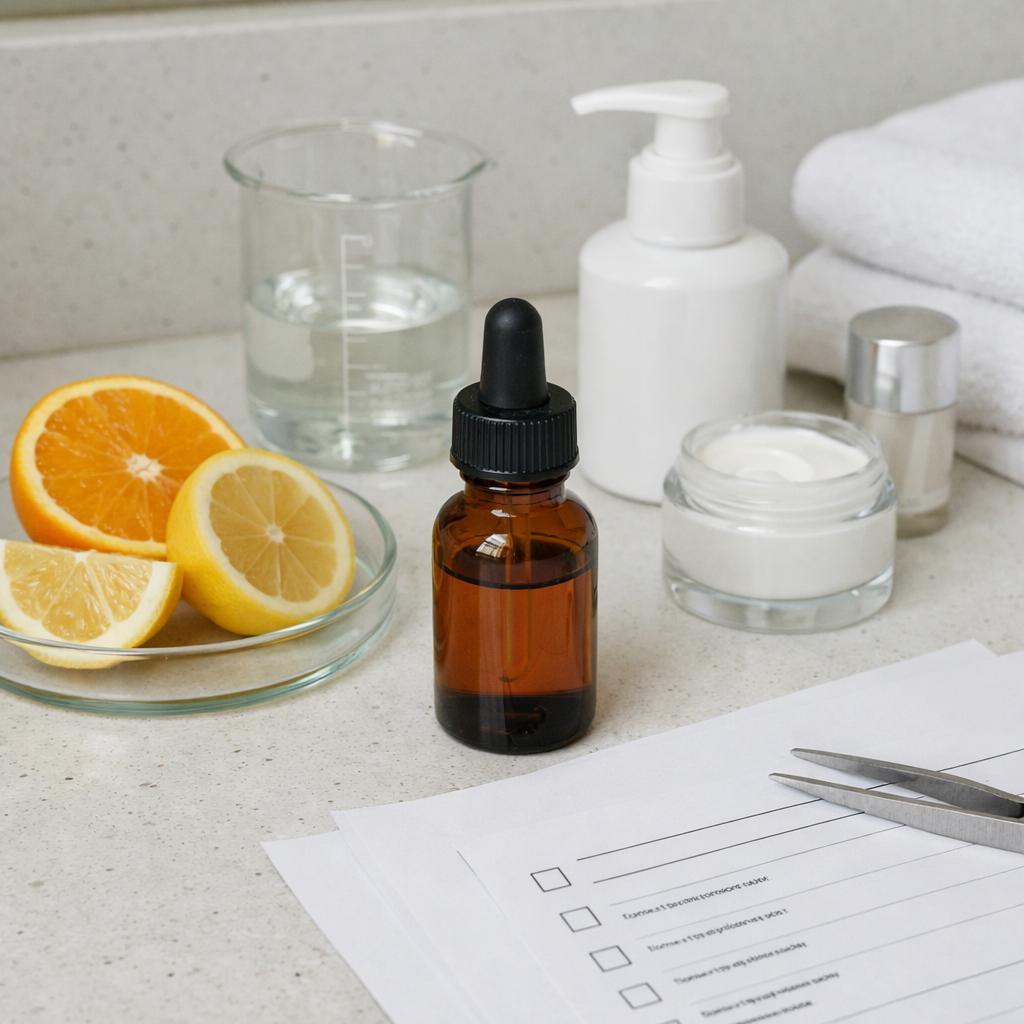
Practical answer: A topical vitamin C serum may gradually support a brighter, more even-looking complexion while providing antioxidant support. It does not replace sunscreen, and performance varies by vitamin C form, formulation, packaging, storage, and skin tolerance. If you are new to vitamin C, consider a lower-strength product or gentler derivative, introduce one active at a time, and follow the product label.
What can vitamin C serum do for skin?
Vitamin C is an antioxidant used in skincare to help limit some effects of environmental oxidative stress. Topical products may also improve the appearance of uneven tone and fine lines with consistent use. Results depend on the form of vitamin C, the complete formula, packaging, application habits, and individual tolerance.
Dark marks and uneven tone
Vitamin C can interfere with steps involved in melanin production, so some formulas may gradually reduce the appearance of discoloration. However, not every serum will fade every type of dark mark. The cause and depth of discoloration matter, and ongoing sun exposure can continue to stimulate pigment.
Changes are usually gradual rather than immediate. Consistent use for several weeks or longer may be needed before assessing a visible difference. Occasional photos taken in similar lighting can be more useful than daily mirror checks, although photos cannot determine why discoloration is present.
Antioxidant support during sun exposure
Vitamin C may provide antioxidant support against some free-radical damage associated with ultraviolet exposure and pollution. It does not block ultraviolet radiation, prevent sunburn, or replace sunscreen, protective clothing, and shade. Broad-spectrum sunscreen used according to its label remains the primary topical step for reducing UV exposure.
Morning use is common because antioxidant support can complement daytime sun protection. The practical priority, however, is choosing a vitamin C product your skin tolerates and applying sunscreen consistently. Irregular serum use cannot compensate for skipped sunscreen.
Fine lines and firmer-looking skin
Vitamin C is involved in collagen production, and topical products may gradually support the appearance of fine lines and firmness. When these changes occur, they are generally subtle. A serum cannot provide the same result as a procedure or guarantee lifting or reversal of sagging skin.
Vitamin C forms are not directly interchangeable
“Vitamin C” is a broad label. Pure L-ascorbic acid and vitamin C derivatives differ in acidity, stability, supporting evidence, and tolerability. Percentages cannot be compared directly across forms: a 10% derivative is not automatically weaker or stronger than a product containing 10% L-ascorbic acid.
The ingredient name, concentration, pH, surrounding ingredients, and packaging all influence how a serum behaves. No single form is best for everyone.
| Form | Typical characteristics | Potential tradeoffs |
|---|---|---|
| L-ascorbic acid | The best-studied direct form; commonly formulated at an acidic pH | May be more prone to stinging and formula instability, especially at higher strengths |
| Magnesium ascorbyl phosphate | A water-soluble derivative often used in gentler, less-acidic formulas | Evidence and performance cannot be assumed to match L-ascorbic acid; product quality varies |
| Ascorbyl glucoside | A derivative often selected for water-based formulas and tolerability | Conversion to active vitamin C in skin and real-world results may vary |
| Tetrahexyldecyl ascorbate | An oil-soluble derivative used in some stable, lower-irritation formulas | Often more expensive, and research on specific finished products remains limited |
| Ascorbyl palmitate | A fat-soluble derivative found in some creams and oil-based products | Effectiveness depends heavily on the overall formula; it is less extensively studied topically |
If sensitivity is a concern, a derivative in a well-formulated product may be a reasonable starting point. If you want the most direct form and can tolerate acidity, L-ascorbic acid may be suitable. “Stronger” is not automatically better: irritation can make regular use difficult and may require stopping the product.
Why formulation, packaging, and storage matter
L-ascorbic acid is vulnerable to oxygen, light, heat, and water exposure. A product can lose potency as it degrades, and an older or unstable formula may become more irritating. Derivatives can have different stability profiles, but they are not immune to degradation.
Packaging that limits repeated exposure to air and light may help protect the formula. Examples include an opaque container, dark bottle, or airless pump. A dropper is not automatically unsuitable, but frequent opening can expose the contents to more air than a well-designed pump. The complete formula, closure, and manufacturer’s directions all matter.
Color change is a useful warning sign, not a precise test of safety or effectiveness. Some formulas may change mildly over time. Treat a product cautiously if it becomes noticeably darker, develops an unusual odor, or changes texture. Follow the brand’s discard guidance rather than attempting to restore it through refrigeration or by mixing it with another serum.
How to use vitamin C serum in a routine
Many people apply vitamin C after cleansing and before moisturizer and sunscreen, often in the morning. This is a common sequence rather than a universal rule. Some products are intended for evening use, so the label should take priority.
- Cleanse gently if cleansing is part of your routine, then pat the skin dry.
- Apply the vitamin C product as directed, using the labeled amount rather than assuming more will work better.
- Follow with moisturizer if desired, especially if the serum feels drying or tight.
- During daytime use, finish with broad-spectrum sunscreen and reapply it according to its label and your exposure.
There is usually no need to wait a fixed number of minutes between every layer. Letting each product settle briefly may improve comfort or reduce pilling, but a long waiting period is not established as necessary for vitamin C to work. If layering causes pilling, use less product, allow layers to settle, or simplify the routine.
Can vitamin C be used with other active ingredients?
Vitamin C can often be included in a routine with other active ingredients, but combining products may increase dryness, burning, or stinging. Compatibility depends on the specific formulas, pH, concentration, vehicle, and your skin’s tolerance.
| Ingredient | Practical approach |
|---|---|
| Retinoids | Using vitamin C in the morning and a retinoid in the evening can avoid layering several potentially irritating products. Follow the prescribing clinician’s instructions for a prescription retinoid. |
| Exfoliating acids | Glycolic, lactic, salicylic, and other exfoliating products may add irritation when paired with an acidic vitamin C serum. Separating them may improve tolerance. |
| Benzoyl peroxide | Benzoyl peroxide can oxidize some topical ingredients, and using multiple potentially irritating products together may be uncomfortable. Follow each label and use separate routines if advised. |
| Niacinamide | Modern formulas commonly use vitamin C and niacinamide together. The claim that they are universally incompatible is too broad, although irritation or pilling can still occur. |
| Moisturizer | A bland, fragrance-free moisturizer may reduce dryness and support comfort, but it cannot guarantee that irritation will be prevented. |
Introducing several actives at once makes it difficult to identify the cause of a reaction. A simpler routine also makes it easier to judge whether vitamin C is providing a worthwhile benefit.
Common vitamin C serum mistakes
Starting with the highest concentration
A high percentage may sound appealing, but greater strength can also mean more acidity or a higher chance of irritation. This is particularly relevant if skincare products often sting your skin. Starting with a lower-strength formula or gentler derivative may be more sustainable than choosing the most concentrated option.
Applying it to already irritated skin
Adding an active serum to skin that is red, peeling, inflamed, or uncomfortable can worsen symptoms. Pause the new product and keep the routine simple until the skin is comfortable, while following any medical instructions already provided. Do not assume irritation is a necessary “purge”; vitamin C is not expected to require a purging period.
Using too much
More serum does not necessarily produce better results. Excess product can increase tackiness, pilling, waste, and irritation. Use the amount recommended by the manufacturer.
Keeping an opened bottle indefinitely
Writing the opening date on the container can help you track its age. Keep the cap or pump closed and store the serum as directed. A cool, dark location is often preferable to a hot, sunny bathroom counter. Refrigeration is not suitable or necessary for every product and may create condensation or inconvenience, so use it only when the label recommends it.
Expecting overnight brightening
Vitamin C does not create an instant filtered effect. Any visible benefit may take weeks and may be modest. If a reasonable trial produces no improvement, or the serum repeatedly causes discomfort, there is no need to continue solely because of marketing claims.
Relying on vitamin C instead of sunscreen
Antioxidant support and UV protection are not the same. Vitamin C does not carry labeled broad-spectrum protection and cannot prevent sunburn. If uneven tone is the goal, consistent sun protection remains foundational.
Who should be cautious?
Extra caution is sensible when skin is uncomfortable, peeling, inflamed, or recovering from a professional procedure. Examples include an active eczema or dermatitis flare, a recent laser treatment or peel, or a period when another prescription or over-the-counter active is already causing significant irritation.
If you have reacted to skincare products before, review the complete ingredient list rather than only the vitamin C form. Fragrance, preservatives, solvents, and botanical extracts may also cause problems. A small-area test may reduce the risk of applying an unfamiliar product broadly, but it cannot guarantee that a reaction will not occur.
Pregnancy, breastfeeding, chronic skin conditions, prescription treatment, and recent procedures may require product-specific guidance. Ask a qualified clinician or pharmacist how a particular formula fits your circumstances, and continue to follow current treatment instructions.
When to stop using the serum
- Stop if persistent burning, pain, swelling, blistering, or marked redness develops.
- Seek advice if a rash worsens or spreads beyond the application area.
- Seek urgent care for facial swelling, trouble breathing, or another possible emergency symptom.
- Obtain professional guidance if repeated use causes irritation despite simplifying the routine and following the label.
- Have a dark spot, changing lesion, persistent sore, or unexplained new discoloration evaluated rather than treating it only as a cosmetic concern.
- Ask for guidance before combining vitamin C with a prescription treatment or using it after a professional procedure when instructions are unclear.
This guide cannot identify the cause of a spot, rash, burning sensation, or texture change or determine which vitamin C concentration will suit an individual. New, worsening, painful, widespread, or unexplained concerns are more appropriate for qualified medical care than another skincare active.
A practical way to choose
If your goal is antioxidant support
Choose clear ingredient labeling and protective packaging, use the product as directed, and prioritize daily broad-spectrum sunscreen. A simple routine used consistently may be more useful than a complex routine that causes frequent irritation.
If your goal is a more even-looking tone
Vitamin C may help some discoloration, but sunscreen is foundational. Choose a serum you can use without persistent stinging and allow several weeks before judging the result.
If your skin is easily irritated
A derivative or lower-strength product may be easier to tolerate than a highly acidic L-ascorbic acid serum. Introduce one change at a time and keep the rest of the routine uncomplicated.
If you already use several actives
Adding vitamin C may not be necessary. Review the full routine and separate potentially irritating products. Seek professional guidance if prescription treatment or procedure aftercare makes the routine difficult to manage.
Before buying
- Identify the vitamin C form rather than relying only on the front-label percentage.
- Check the concentration and any directions about frequency of use.
- Look for packaging that limits unnecessary light and air exposure.
- Review the expiration or period-after-opening guidance.
- Confirm that the storage instructions suit where you plan to keep the product.
After opening
- Keep the container properly closed.
- Use the labeled amount and frequency.
- Watch for substantial changes in color, odor, or texture.
- Stop if significant or persistent irritation develops.
- Do not keep using a degraded or uncomfortable formula simply to finish the bottle.
Frequently asked questions
Should vitamin C serum be used in the morning or at night?
Morning use is common because vitamin C can complement a daytime antioxidant and sunscreen routine. Night use may also be appropriate when the label supports it or morning layering is uncomfortable. The best timing depends on the formula and whether you can use it consistently without irritation.
Can vitamin C replace sunscreen?
No. Vitamin C does not provide labeled broad-spectrum UV protection and cannot replace sunscreen, shade, or protective clothing. Apply sunscreen according to its label whenever daytime exposure is expected.
What does it mean if a vitamin C serum turns orange or brown?
Noticeable darkening may indicate oxidation or another formula change. Do not assume the serum is still performing as intended. Check the manufacturer’s guidance and consider discarding it if its color, odor, or texture has changed substantially.
Is a higher percentage of vitamin C better?
Not necessarily. Higher concentrations may be more irritating, and percentages cannot be compared directly between L-ascorbic acid and derivatives. A tolerated product used consistently may be more practical than a stronger serum that causes discomfort.
Can vitamin C cause purging?
Purging is not an expected requirement of vitamin C use. New or worsening bumps, burning, itching, or a rash may indicate irritation or sensitivity instead. Stop using the product if symptoms are significant or persistent and seek professional advice when needed.
How long does vitamin C take to work?
Visible changes are generally gradual and may require consistent use for several weeks or longer. Results may be modest and depend on the concern, formula, application habits, sun exposure, and skin tolerance.
Bottom line: Topical vitamin C may support a brighter, more even-looking complexion and provide antioxidant support, but results depend on the specific formula and your ability to tolerate it. Choose the form and strength thoughtfully, follow the label, monitor the serum for degradation, and keep broad-spectrum sunscreen at the center of daytime skincare.
Sources and further reading
These resources provide additional medical and regulatory context:
- How to fade dark spots in darker skin tones — American Academy of Dermatology Association
- Anti-aging skin care — American Academy of Dermatology Association
- Sun protection — American Academy of Dermatology Association
Safety note
This guide provides general education rather than diagnosis or individualized treatment. Follow current product and treatment instructions, and seek qualified care for severe, persistent, painful, rapidly changing, or otherwise concerning symptoms.