
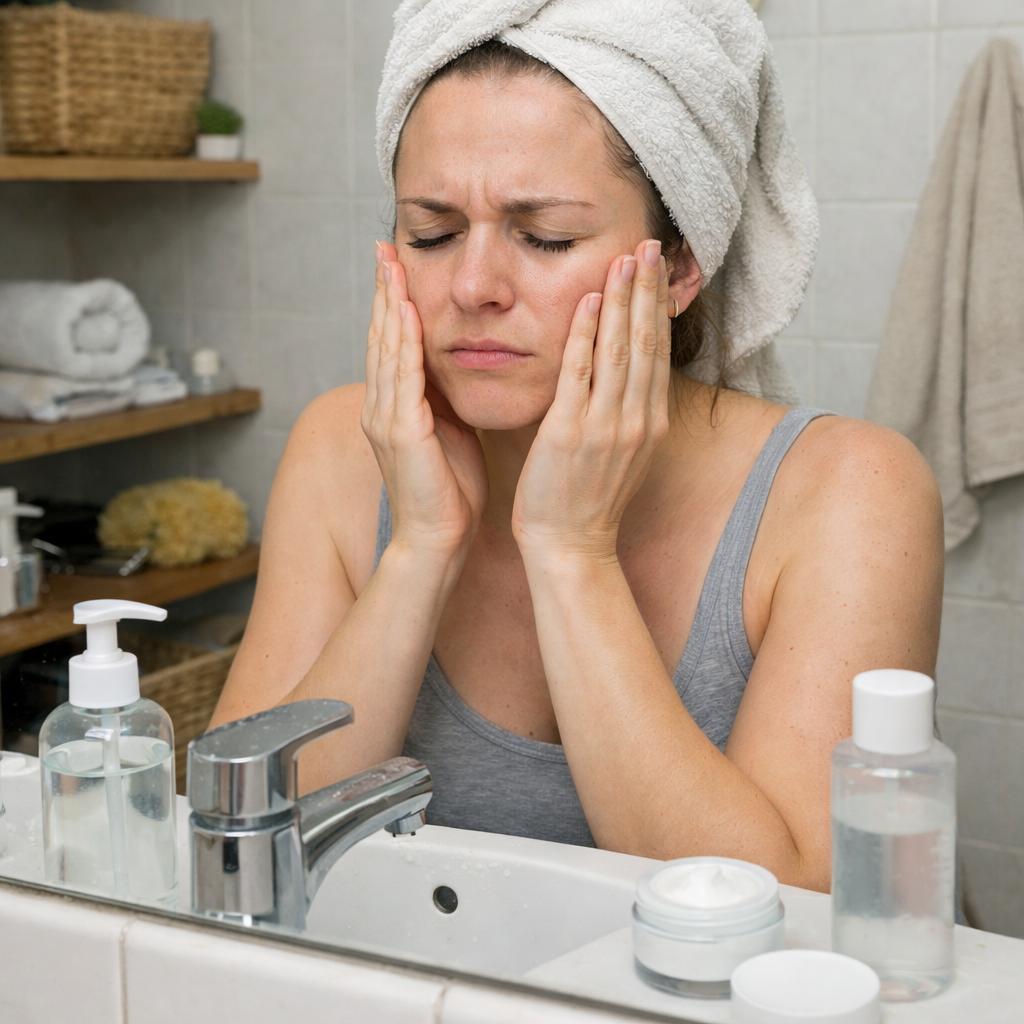
Skin that feels tight, pulled, dry, or unusually shiny after washing may be reacting to the cleanser, washing technique, or surrounding environment. Tightness does not reliably mean that skin is especially clean, nor does it identify one specific condition. Start by using lukewarm water, avoiding scrubbing, rinsing thoroughly, patting rather than rubbing, and applying a plain moisturizer while the skin is still slightly damp. If tightness continues despite gentle changes, or occurs with persistent redness, scaling, burning, swelling, or cracking, professional advice can help clarify the cause.
What is the quickest way to reduce tightness after washing?
For the next few washes, simplify rather than adding more products. Use a gentle cleanser intended for the face and follow its label directions. Keep contact brief, use lukewarm water, and avoid brushes, scrubs, rough washcloths, and vigorous towel drying. Pat the skin dry and apply a fragrance-free moisturizer soon afterward while the skin is still slightly damp. If tightness began after adding an exfoliant, retinoid, fragranced product, or another new formula, review the product directions before making further changes. Do not stop a prescribed treatment without speaking with the prescriber.
Why can skin feel tight after washing?
Tightness is a sensation rather than a finding that points to one cause. Washing temporarily removes some surface oil and water. If the cleanser, water temperature, friction, or washing frequency is more than the skin comfortably tolerates, the result may feel like pulling or dryness. A cleanser can also leave skin feeling squeaky or unusually smooth, which may be interpreted as cleanliness even when the sensation is uncomfortable.
Common contributors include:
- Cleanser strength or formula: Some soaps and cleansers remove oil efficiently and may feel drying, especially when used frequently or on already sensitive skin.
- Water temperature: Very hot water can increase discomfort and may remove more surface oil than lukewarm water.
- Friction: Scrubbing, facial brushes, textured cloths, and vigorous drying can add irritation to the washing process.
- Frequent or prolonged washing: Multiple cleansing steps, long showers, or repeated washing after sweating may exceed what a person’s skin tolerates.
- Dry surroundings: Indoor heating, air conditioning, wind, and low humidity can make post-wash dryness more noticeable.
- Recent product changes: Exfoliating acids, retinoids, acne treatments, fragranced products, and other active formulas may contribute to sensitivity or dryness.
Tightness can also occur when skin is already dry or irritated for reasons unrelated to cleansing. The sensation alone cannot establish that a cleanser is too alkaline, that the skin barrier is damaged, or that one particular ingredient is responsible.
Which cleanser factors are worth checking?
Does more foam mean a cleanser is stronger?
Not necessarily. Foam describes aspects of a product’s texture and surfactant system; it does not by itself determine how drying the cleanser will feel. Foaming and low-foaming formulas may each be comfortable or uncomfortable depending on their complete formulation, contact time, rinse-off behavior, and the person using them.
A creamy, milky, gel, or low-foaming cleanser may be worth considering if the current product leaves skin persistently tight, but texture alone does not guarantee gentleness.
Does cleanser pH explain the problem?
Cleanser pH can affect how a formula interacts with skin, but it is only one part of the picture. A “pH balanced” claim is not a substitute for checking the complete label and observing how the product feels. Home pH testing can be difficult to interpret and does not measure a cleanser’s overall irritation potential. A single pH number cannot reliably predict an individual response.
Should certain ingredients always be avoided?
No ingredient list can identify the best cleanser for everyone. Some people find particular surfactants, fragrances, essential oils, preservatives, or other ingredients uncomfortable, while others tolerate them. Glycerin, panthenol, and ceramides are often included in moisturizing or skin-comfort formulas, but their presence does not guarantee that a cleanser will prevent tightness. Because cleansers are rinsed off, their contact time is also limited.
How do water, technique, and timing matter?
What water temperature is best?
Lukewarm water is a practical starting point because it is less likely than very hot water to increase dryness or flushing. The temperature does not need to be measured. If the water feels hot, uncomfortable, or leaves the face visibly flushed, turn it down. Very cold water may feel refreshing, but it is not required for effective cleansing and may be uncomfortable for some people.
How much rubbing is too much?
Use light fingertips and short, gentle movements. Let the cleanser do most of the work rather than trying to create a squeaky finish. Rinse completely, then press a clean, soft towel against the skin. Repeated wiping, rubbing, or using a rough towel increases friction. Facial brushes and scrubs are not necessary for routine cleansing.
Should the face be washed once or twice daily?
There is no universal schedule. Some people wash in the morning and evening; others may prefer a water rinse in the morning and cleanser later, particularly if morning cleansing repeatedly feels drying. Sweat, sunscreen, makeup, occupational exposure, and skin comfort all matter.
More frequent washing is not automatically better, but reducing cleansing may not be appropriate if it leaves sunscreen, makeup, or other residue on the skin. Follow product directions and aim for an approach that cleans without causing ongoing discomfort.
When should moisturizer be applied?
Apply moisturizer soon after washing while the skin is slightly damp rather than dripping wet. This may help limit water loss from the surface and reduce the dry feeling. Creams and ointments are generally more substantial than lotions, while gels and lighter lotions may feel more comfortable for some people. Moisturizers may contain humectants, emollients, or occlusive ingredients, but no category guarantees a particular result.
What changes are worth making first?
Changing several products at once makes it difficult to tell what helped or caused discomfort. A step-by-step review is usually more informative than a complete routine overhaul.
A simple review process
- Notice the pattern. Record when tightness occurs, whether it follows a particular cleanser, and whether it improves after moisturizing. Note any burning, itching, redness, flaking, or swelling.
- Check the washing process. Consider water temperature, cleansing time, pressure, towel friction, and whether multiple cleansing products are being used.
- Simplify carefully. Use one suitable cleanser as directed and one moisturizer you already tolerate instead of introducing several new products.
- Review recent additions. Look at products introduced shortly before the sensation began. If a medicine may be involved, ask the prescriber how to handle possible irritation rather than discontinuing it yourself.
- Reassess without rushing. If the skin becomes more comfortable, keep the routine steady. If symptoms persist or worsen, seek professional input instead of repeatedly switching products.
Which routine factors may be contributing?
| What to check | What may contribute to tightness | A reasonable adjustment |
|---|---|---|
| Water | Very hot or prolonged exposure | Use comfortably lukewarm water and shorten contact time |
| Cleansing | A strong-feeling cleanser, repeated washing, or several cleansing steps | Review the label and use a simpler cleanser intended for the face |
| Friction | Scrubs, brushes, textured cloths, or vigorous towel drying | Use fingertips and pat dry with a soft towel |
| Moisturizing | Skipping moisturizer when dryness is present | Apply a tolerated moisturizer soon after washing |
| Recent products | New exfoliants, retinoids, acne products, fragrance, or other actives | Review directions and seek advice before changing prescribed treatment |
| Environment | Cold wind, dry indoor air, heating, or air conditioning | Limit direct airflow and consider whether a more substantial moisturizer feels appropriate |
What can post-wash tightness tell you?
Post-wash tightness can suggest that the current cleansing process is not comfortable for your skin. It may also reflect temporary dryness, environmental exposure, friction, or a response to another product. The sensation cannot tell you that a product is “detoxing,” that pores are cleaner, or that a specific skin condition is present.
It also cannot confirm that the skin barrier is damaged. Persistent tightness has several possible explanations and may need an in-person assessment when other symptoms occur. Likewise, the absence of tightness does not prove that a cleanser is ideal or that a routine is harmless. Consider the broader pattern, including comfort, redness, scaling, burning, itching, swelling, cracking, and changes over time.
Who should be cautious with routine changes?
Use extra care if you have a history of eczema, rosacea, contact reactions, significant sensitivity, or frequent irritation. People using prescription or over-the-counter acne treatments, retinoids, exfoliating acids, or other active products may be more prone to dryness, but the appropriate response depends on the product and any medical instructions. A very simple routine is not automatically suitable for every skin concern.
Children, people with complex medical conditions, and anyone with symptoms involving the eyes or lips should not rely on general skincare guidance alone. If a product was recommended or prescribed for a condition, check with the relevant clinician before stopping it, replacing it, or changing how often it is used.
Stop and seek professional advice if
- tightness is persistent, worsening, or interfering with sleep, work, or normal activities;
- the skin develops ongoing redness, marked burning, intense itching, swelling, hives, blisters, open areas, or painful cracks;
- symptoms affect the eyelids, eyes, lips, or breathing, or swelling develops quickly;
- a product reaction is severe, widespread, or continues after the product is removed;
- repeated changes to cleansers and moisturizers have not improved the problem; or
- you are unsure whether a prescribed treatment should be continued or adjusted.
Rapid swelling, trouble breathing, or symptoms involving the eyes require urgent medical attention. For less urgent but persistent concerns, a qualified clinician can assess the timing, products, symptoms, and treatment history rather than relying on the tight sensation alone.
A practical way to decide what to do next
If tightness is mild and short-lived
Check water temperature, pressure, cleanser contact time, and towel friction. Apply a tolerated moisturizer after washing and keep the routine steady rather than adding more products.
If tightness began after a product change
Read the label, consider every product introduced around the same time, and avoid making several additional changes. If the product is prescribed, ask the prescriber for instructions before altering it.
If tightness comes with other symptoms
Do not assume it is simply a cleanser problem. Persistent redness, itching, burning, scaling, swelling, or cracking is a reason to seek professional advice.
A comfortable post-wash feeling is a more useful goal than a tight or squeaky finish. Begin with low-risk technique changes, choose products according to their labels and your known tolerances, and consider the full symptom pattern. If the problem does not settle or keeps returning, individualized care is more appropriate than continued product experimentation.
Frequently asked questions
Is tight skin after washing a sign that the face is clean?
No. Tightness may reflect water and oil removal, friction, product irritation, or dry surroundings. Cleanliness cannot be judged by how pulled or squeaky the skin feels.
Can hot water cause tightness?
It can contribute, particularly when washing is prolonged. Lukewarm water is a practical alternative. The exact temperature matters less than avoiding water that feels hot or uncomfortable.
Is a foaming cleanser always too harsh?
No. Foam alone does not determine whether a cleanser will dry or irritate the skin. Consider the complete formula, directions, contact time, washing technique, and how your skin responds.
Does moisturizer have to be applied within one minute?
No exact deadline is required. Applying it soon after washing while the skin is slightly damp may help, but comfort and product tolerability matter more than a precise time.
Should exfoliants or retinoids be stopped if washing causes tightness?
Do not change a prescribed treatment without medical advice. Review the product directions and ask a qualified clinician or pharmacist whether the timing, frequency, or combination of products needs attention.
Sources and further reading
These resources provide general medical and skincare context:
- How to relieve dry skin — American Academy of Dermatology Association
- Skin care basics — American Academy of Dermatology Association
- Face washing 101 — American Academy of Dermatology Association
Safety note
This guide provides general education rather than diagnosis or individualized treatment. Read current product labels, follow instructions for prescribed medicines, and seek qualified care for severe, persistent, painful, rapidly changing, or otherwise concerning symptoms.